
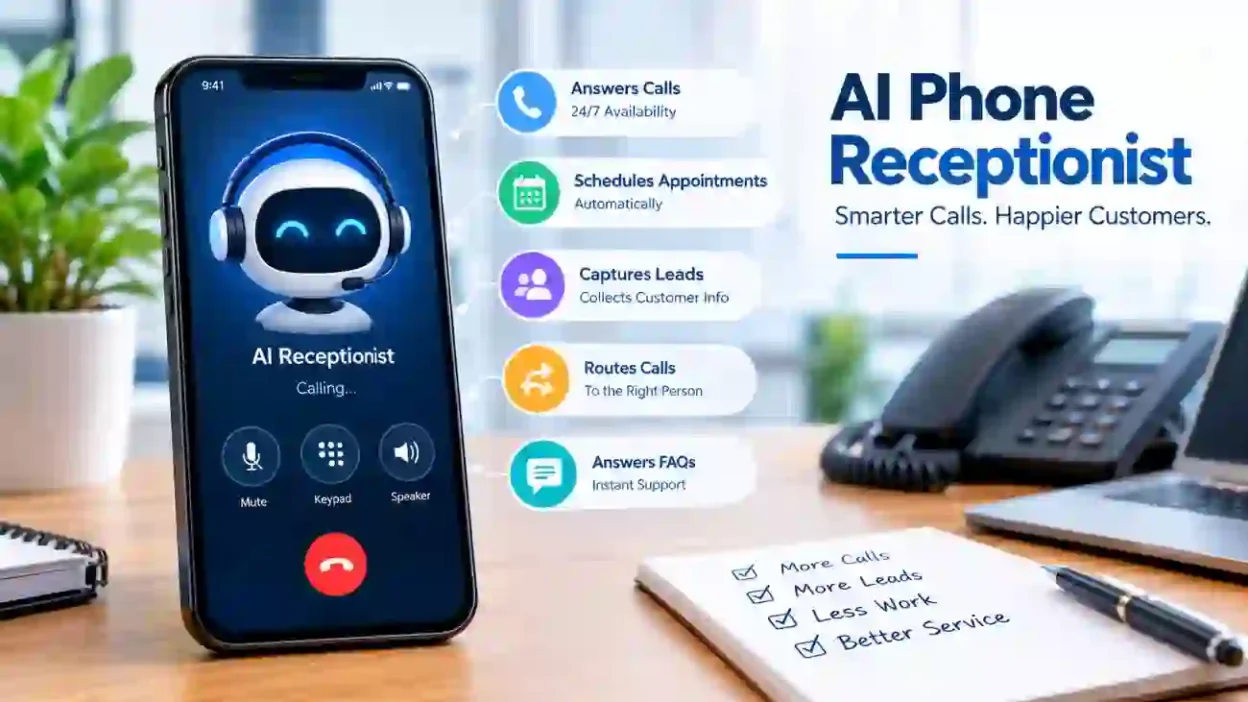
An AI phone receptionist is a virtual assistant that answers business calls, responds to common questions, collects caller information, schedules appointments, and routes calls automatically.
Using artificial intelligence and voice technology, it can handle routine conversations around the clock, helping businesses reduce missed calls, improve customer service, and save staff time.
Key Takeaways
- An AI phone receptionist answers incoming business calls using conversational voice technology.
- It can manage common questions, appointment bookings, call transfers, and lead collection.
- Small businesses can use AI receptionists to handle calls outside regular office hours.
- Costs, integrations, voice quality, and available features vary by provider.
- Human support remains important for sensitive, complex, or urgent customer requests.
AI Phone Receptionist: How It Works, Benefits, and Costs
Every missed business call can mean a lost customer, a missed appointment, or a new lead going to a competitor. However, hiring someone to answer every call can be expensive, especially for small businesses with limited staff.
An AI phone receptionist offers another option. It uses artificial intelligence to answer calls, understand spoken questions, and respond with natural-sounding speech. Depending on the software, it can also book appointments, collect contact details, answer frequently asked questions, and transfer callers to the right person.
Businesses across the United States are exploring virtual receptionists to improve customer service without adding another full-time employee. From home service companies to medical offices and professional firms, automated phone answering can help manage busy periods and after-hours calls.
In this guide, you’ll learn how an AI receptionist works, which features matter most, how much it may cost, and what to consider before choosing a solution for your business.
What Does an AI Phone Receptionist Mean?
An AI phone receptionist is software that handles incoming phone calls using artificial intelligence, speech recognition, and voice generation. It communicates with callers, gathers information, and performs specific tasks according to the business’s instructions.
Unlike a traditional answering machine, it can respond to questions and adjust its conversation based on what the caller says. For example, someone calling a plumbing company might ask about service availability, explain a leaking pipe, and request an appointment.
Depending on its capabilities, the AI system may collect the caller’s details, check an integrated scheduling system, and arrange a callback or booking.
Businesses commonly use this technology in healthcare administration, real estate, home services, legal offices, salons, and other industries that receive regular customer calls.
Why Use an AI Phone Receptionist?
Businesses choose AI phone receptionists for several practical reasons. They want to answer more calls, reduce repetitive work, and provide a reliable customer experience without requiring employees to manage every routine conversation.
Common benefits include:
- Fewer missed calls: Answer incoming calls during busy periods or outside office hours.
- Lower staffing demands: Automate repetitive questions instead of assigning every call to an employee.
- Better lead capture: Collect names, phone numbers, service requests, and other relevant details.
- Convenient scheduling: Book appointments when connected to a compatible calendar.
- Consistent service: Give callers the same approved information about business hours, services, and policies.
- Improved flexibility: Handle changing call volumes without immediately hiring additional reception staff.
These benefits depend on the software’s capabilities, setup, and integration with existing business systems. An AI receptionist works best when it has accurate information and clear rules for handling requests it cannot resolve.
10 Best Ways an AI Phone Receptionist Can Help Your Business
1. Answer Calls 24/7
An AI phone receptionist can answer calls outside normal business hours when the service supports continuous availability.
This helps businesses serve customers who call early in the morning, late at night, or during weekends. Instead of reaching voicemail, callers can receive basic information or leave a structured request.
Example: A homeowner calls an HVAC company at 8:30 p.m. The AI answers, collects the address and service issue, and records a request for follow-up.
Best for: Home services, property management, and businesses that receive after-hours inquiries.
2. Schedule Appointments Automatically
Some AI receptionists can connect to scheduling software to check available time slots and book appointments during a phone conversation.
The system can ask about the requested service, preferred date, and contact information. It should confirm the booking only after the scheduling system verifies that the appointment has been created.
Example: A salon customer calls to schedule a haircut. The receptionist checks the available calendar, offers suitable times, and confirms the selected appointment.
Best for: Salons, dental offices, consultants, and appointment-based businesses.
3. Capture New Leads
An AI receptionist can collect information from potential customers and send it to a CRM or lead management system.
Depending on the setup, it may ask about the requested service, location, budget range, and preferred callback time. Sales staff can then prioritize leads using the information collected.
Example: Someone calls a roofing company to request an estimate. The AI records the caller’s details and the type of roofing work needed.
Best for: Contractors, real estate agents, marketing agencies, and sales teams.
4. Route Calls to the Right Person
Call routing directs callers to the appropriate employee, department, or phone number.
An AI receptionist can ask why someone is calling and use the answer to determine where the call should go. More advanced systems can follow rules for business hours, staff availability, and escalation.
Example: A customer calls an insurance agency to ask about an existing policy. The AI identifies the request and transfers the caller to the appropriate team.
Best for: Companies with multiple departments or employees.
5. Handle Frequently Asked Questions
Businesses often receive the same questions about opening hours, locations, prices, services, and appointment policies.
An AI phone receptionist can answer these questions using an approved knowledge base. This reduces repetitive interruptions and gives callers quick access to basic information.
Example: A customer calls a repair shop to ask whether it accepts weekend appointments. The AI provides the shop’s published scheduling information.
Best for: Retail stores, service businesses, and customer support teams.
6. Reduce Administrative Work
After a call, an AI system may create a summary, record contact details, and send a notification to the appropriate employee.
These automated tasks reduce the need to listen to every call again or manually transfer information into business software.
Example: A property manager receives a summary of a tenant’s maintenance request, including the reported problem and the best time to return the call.
Best for: Property managers, small offices, and busy service teams.
7. Support Multilingual Callers
Some AI receptionists support multiple languages, allowing callers to communicate in a language they are comfortable using.
However, supported languages, accent recognition, and translation quality differ between providers. Businesses should test the actual voice experience before relying on multilingual service for important conversations.
Example:
A customer asks a question in Spanish, and a multilingual system responds in Spanish if that language is supported and configured.
Best for:
Businesses serving diverse communities or customers across different regions.
8. Manage High Call Volumes
A traditional receptionist can handle only a limited number of conversations at once. Depending on its design and subscription limits, an AI receptionist may manage several calls simultaneously.
This can help during seasonal demand, advertising campaigns, or unexpected increases in customer inquiries.
Example:
A landscaping company receives a surge of calls after a local storm. The AI answers routine inquiries and records service requests while employees handle urgent jobs.
Best for:
Seasonal businesses, growing companies, and busy customer service teams.
9. Improve After-Hours Lead Follow-Up
Some systems can qualify leads and arrange callbacks without requiring a salesperson to answer immediately.
The AI may identify the caller’s needs, collect contact information, and send the details to the sales team. More advanced integrations may also create tasks or trigger follow-up workflows.
Example:
A prospective buyer calls a real estate office after closing time. The AI records the type of property the caller wants and alerts an agent.
Best for:
Real estate agencies, consultants, and businesses that depend on incoming leads.
10. Provide Consistent Call Handling
An AI receptionist follows configured instructions, approved answers, and escalation rules. This can help businesses maintain a consistent first point of contact.
However, consistency depends on accurate information and careful testing. The system should recognize when a question falls outside its knowledge and offer an appropriate next step instead of guessing.
Example:
A caller asks about a service that the company does not provide. The AI explains the limitation and offers to connect the caller with a staff member.
Best for:
Businesses that want predictable communication and standardized intake procedures.
How Does an AI Phone Receptionist Work?
An AI phone receptionist typically combines several technologies to handle a conversation from beginning to end.
- Call connection: The phone system forwards an incoming call to the AI service.
- Speech recognition: The software converts the caller’s spoken words into information the system can process.
- Intent detection: The AI identifies what the caller wants, such as an appointment, service quote, or general answer.
- Response generation: It selects an appropriate response using its instructions, business information, and connected tools.
- Voice response: The system speaks to the caller using a generated voice.
- Task completion: If configured, it books appointments, transfers calls, saves details, or sends a summary.
The process can happen in real time, but performance depends on network quality, system design, and integration reliability.
Before launching the service, businesses should test common questions, unexpected requests, background noise, and situations requiring human assistance.
How Much Does an AI Phone Receptionist Cost?
AI receptionist pricing varies by provider, subscription level, call volume, and included features. Some services charge a monthly subscription, while others bill by the minute, call, or usage tier.
The following figures are illustrative budgeting ranges, not verified quotes from specific providers.
| Service type | Illustrative monthly cost | Common use |
|---|---|---|
| Basic automated answering | $20–$75 | Simple call handling |
| AI receptionist for a small business | $75–$250 | Routine conversations and lead capture |
| Advanced AI phone service | $250–$600+ | More call volume and integrations |
| Custom business solution | Varies | Complex workflows and specialized needs |
Additional charges may apply for phone numbers, setup, integrations, premium voices, call recordings, or usage beyond plan limits.
When comparing providers, calculate the expected monthly cost using your actual call volume and average call duration. Also check whether appointment booking, call transfers, CRM integrations, and human escalation are included or sold separately.
How to Choose the Right AI Phone Receptionist
The right solution should fit your business’s call patterns, budget, and customer expectations.
Consider these factors before purchasing:
- Voice quality: Does the AI sound clear and handle ordinary speech naturally?
- Useful features: Can it perform the tasks your customers actually need?
- Integrations: Does it work with your phone system, calendar, and CRM?
- Pricing: Are usage limits and additional fees easy to understand?
- Customization: Can you set business hours, approved answers, and transfer rules?
- Privacy and security: How does the provider store, protect, and delete call data?
- Human escalation: Can callers reach a person when the AI cannot help?
- Reporting: Can you review call outcomes, missed requests, and system errors?
Request a demonstration and test realistic calls before committing to a long-term plan. A tool that works well for a simple appointment-based business may not be suitable for a company with complex customer support needs.
Common Mistakes When Using an AI Phone Receptionist
1. Expecting the AI to Handle Everything
AI receptionists can struggle with unusual questions, emotional conversations, and complicated requests. Define clear limits and provide a reliable path to human assistance.
2. Using Outdated Business Information
Incorrect hours, prices, or service details can frustrate customers. Keep the AI’s knowledge base updated whenever business policies change.
3. Ignoring Privacy Requirements
Calls may contain personal or sensitive information. Review applicable privacy laws, recording consent rules, retention policies, and vendor security practices before deployment.
4. Failing to Test Real Conversations
A scripted demonstration may not reflect real customer behavior. Test interruptions, unclear speech, unexpected questions, and requests the system should not handle independently.
5. Measuring Success Only by Cost
A low monthly fee does not guarantee good results. Track missed calls, successful bookings, qualified leads, customer complaints, and transfers to human staff to evaluate the service properly.
Frequently Asked Questions
1. What is an AI phone receptionist?
An AI phone receptionist is software that answers calls and communicates with customers using artificial intelligence and voice technology. Depending on its features, it can answer common questions, collect caller information, schedule appointments, route calls, and record messages. Businesses use it to manage routine calls and reduce the workload on employees.
2. Is an AI phone receptionist suitable for small businesses?
Yes. Small businesses can use AI receptionists to answer calls when employees are busy, serving customers, or away from the office. They are particularly useful for businesses that receive regular appointment requests or service inquiries. The best choice depends on call volume, monthly budget, integration needs, and how often callers require human assistance.
3. Can an AI receptionist answer calls 24/7?
Many AI receptionist services offer round-the-clock answering, including weekends and holidays. However, availability can depend on the provider’s plan, technical reliability, and configuration. Before purchasing, confirm whether continuous call answering is included, whether usage limits apply, and what happens if the service experiences an outage.
4. Can an AI phone receptionist book appointments?
Yes, some AI receptionists can book appointments when connected to compatible scheduling software. They may check availability, collect customer details, and confirm a booking after the calendar accepts it. Businesses should verify that the integration prevents scheduling conflicts and sends accurate confirmations, reminders, or cancellation updates when those features are needed.
5. How much does an AI phone receptionist cost?
Costs depend on the provider, call volume, and available features. Basic services may have relatively low monthly fees, while advanced systems with integrations and higher usage can cost more. Compare total expected costs, including setup, usage overages, phone numbers, and optional features, rather than choosing a plan based only on its advertised starting price.
6. Can customers tell they are speaking to an AI receptionist?
Sometimes. Modern AI voices can sound natural, but callers may notice pauses, unusual responses, or limited understanding of complex questions. Businesses should introduce the service transparently, test the voice quality, and make human assistance available when needed. Clear communication helps set realistic expectations and supports customer trust.
7. Is an AI receptionist better than a human receptionist?
Neither option is best for every business. AI receptionists can handle routine calls consistently and may offer service outside normal office hours. Human receptionists bring judgment, empathy, and flexibility to complicated situations. Many businesses benefit from combining the two, letting AI handle common requests while employees manage exceptions and sensitive conversations.
8. Is an AI phone receptionist safe for customer information?
It can be used responsibly, but safety depends on the provider’s security practices and how the business configures the service. Review encryption, access controls, data retention, recording policies, and contractual terms. Businesses handling health, financial, or other sensitive information should also assess applicable legal requirements and avoid collecting information the AI does not need.
Conclusion
An AI phone receptionist can help businesses answer calls, capture leads, schedule appointments, and manage routine customer questions with less manual effort.
It can be especially valuable for small businesses that cannot afford dedicated reception coverage throughout the day.
Choosing the right service starts with understanding your needs. Consider your average call volume, the questions customers ask most often, the software you already use, and the level of human support your callers expect.
Then compare providers based on voice quality, integrations, privacy practices, and total cost.
Remember that automation should make customer service easier, not create another obstacle. Keep business information accurate, test the system regularly, and provide a clear way to reach a person.