
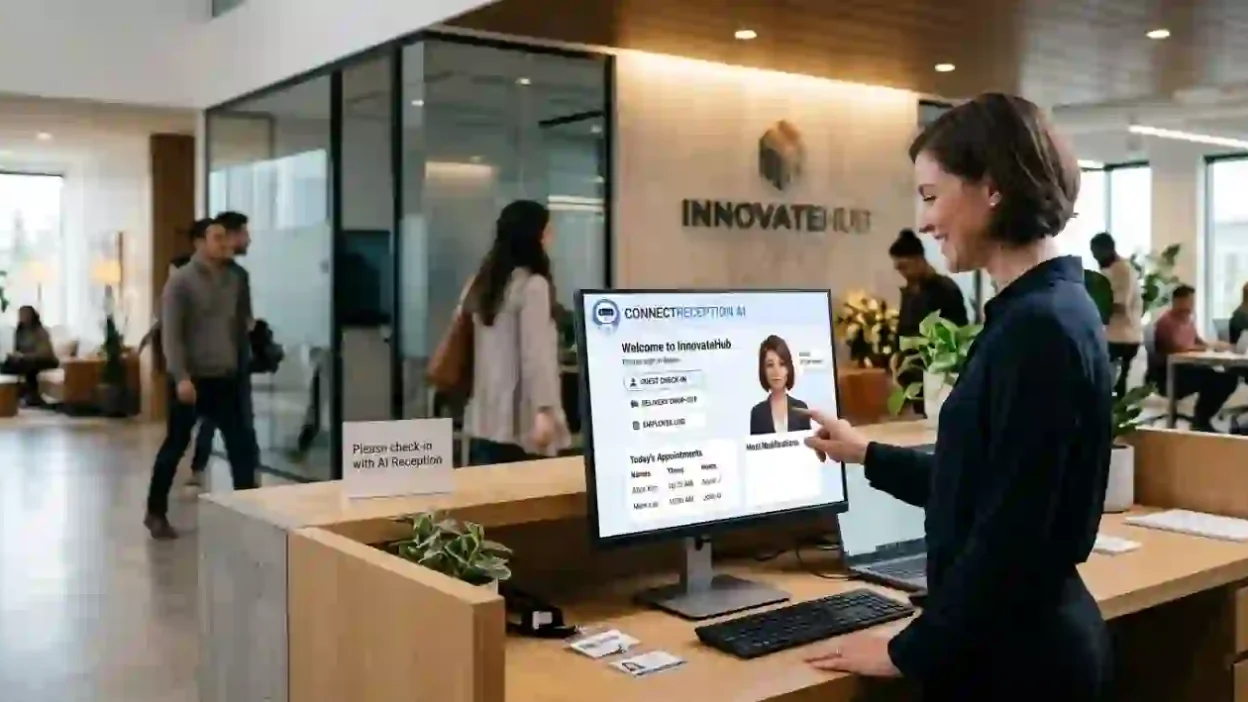
AI receptionist software uses artificial intelligence to answer business calls, respond to common questions, schedule appointments, collect caller information, and route calls to the right person.
Unlike traditional voicemail, it can interact with callers in real time. Businesses use it to handle calls around the clock, reduce missed opportunities, and improve customer service.
Key Takeaways
- AI receptionist software answers incoming calls and handles routine customer questions automatically.
- It can schedule appointments, capture leads, transfer calls, and provide basic business information.
- Small businesses can use it to manage calls without hiring a full-time receptionist.
- Features, pricing, integrations, and voice quality vary between providers.
- Businesses should review privacy, security, escalation options, and call-handling accuracy before choosing a system.
ai receptionist software
Imagine running a small business while helping a customer, meeting with a client, or working on an important project. Your phone keeps ringing, but you cannot answer every call. Each missed call could mean a lost appointment, an unanswered question, or a potential customer choosing another company.
AI receptionist software helps solve this problem by answering calls and handling common tasks automatically. It uses artificial intelligence to understand callers, provide relevant information, and complete actions based on your business rules.
For businesses in the United States, this technology offers a practical way to improve phone coverage without adding more administrative work. However, not every system offers the same features, and some still need human support for complex requests.
In this guide, you will learn what AI receptionist software means, how it works, which features matter, and how to choose a solution that fits your business.
What Does “AI Receptionist Software” Mean?
AI receptionist software is a digital phone assistant that uses artificial intelligence to manage incoming business calls. It can listen to a caller, interpret the request, respond using a generated or prerecorded voice, and perform supported tasks.
For example, a dental office could use an AI receptionist to answer questions about office hours, help patients request appointments, and transfer urgent calls to staff. A plumbing company might use one to collect service details and direct emergency requests to an available technician.
Traditional voicemail records messages for someone to review later. An AI receptionist can have a conversation immediately and may resolve the caller’s request without requiring an employee to answer.
These systems are commonly used by medical and dental offices, law firms, home service companies, real estate agencies, salons, and other businesses that depend on phone communication.
Why Use AI Receptionist Software?
Businesses use AI receptionists to improve call handling, reduce repetitive tasks, and make it easier for customers to reach them.
Common benefits include:
- Fewer missed calls: Calls can be answered when employees are busy or unavailable.
- Extended availability: Depending on the service, callers can receive assistance outside regular business hours.
- Less administrative work: The software can handle routine questions and appointment requests.
- Better lead capture: It can collect names, phone numbers, and details about potential customers.
- More consistent service: It follows configured instructions instead of relying on staff to remember every routine response.
- Flexible staffing: Employees can focus on work that requires human attention.
These benefits depend on the system’s capabilities and how well it is configured. An AI receptionist is not a complete replacement for human staff, especially when callers need judgment, empathy, or specialized assistance.
10 Best Alternatives to AI Receptionist Software
Businesses searching for AI receptionist software may also encounter other terms describing similar services. The following 10 alternatives help explain the available options and their differences.
1. Virtual Receptionist Software
Meaning
Virtual receptionist software helps businesses manage incoming calls through a digital system or remote receptionist service. Depending on the provider, it may include automated responses, human call answering, or a combination of both.
Best For: Professional, Formal
Example 1:
Our virtual receptionist software helps customers reach the right department without waiting for an available employee.
Example 2:
The accounting firm uses virtual receptionist software to manage calls while its staff meets with clients.
Quick Tip:
Check whether the service uses AI, human operators, or both before comparing it with other products.
2. AI Phone Answering Service
Meaning
An AI phone answering service uses artificial intelligence to respond to incoming calls. It can answer common questions, gather information, and direct callers according to your instructions.
Best For: Professional, Friendly
Example 1:
We added an AI phone answering service to respond to customer calls during our busiest hours.
Example 2:
The repair company relies on an AI phone answering service to collect job details after closing time.
Quick Tip:
Look for natural conversations, accurate responses, and reliable transfers to human staff.
3. Automated Receptionist System
Meaning
An automated receptionist system handles routine front-desk tasks with limited manual involvement. Depending on its design, it may use AI conversations, voice menus, or predefined workflows.
Best For: Professional, Formal
Example 1:
Our automated receptionist system directs billing questions to the correct team.
Example 2:
The new system provides office hours and location details without requiring an employee to answer.
Quick Tip:
Confirm whether the system can understand spoken requests or only follow fixed menu options.
4. Virtual Phone Assistant
Meaning
A virtual phone assistant helps manage business calls through voice-based interactions. It may answer questions, collect caller details, transfer calls, and connect with other business tools.
Best For: Casual, Professional
Example 1:
A virtual phone assistant helps our sales team capture inquiries while representatives are on other calls.
Example 2:
Customers can use the virtual phone assistant to find out when our showroom opens.
Quick Tip:
Choose a system that supports the tasks your callers request most often.
5. AI Call Answering Software
Meaning
AI call answering software focuses on answering and managing incoming calls using artificial intelligence. Some products provide advanced conversations, while others specialize in basic call screening and routing.
Best For: Professional, Formal
Example 1:
Our AI call answering software handles routine inquiries before transferring customers to a specialist.
Example 2:
The property management company uses AI call answering software to collect information about maintenance requests.
Quick Tip:
Review how the software handles unclear speech, interruptions, and callers who need a person.
6. Automated Phone Assistant
Meaning
An automated phone assistant performs routine tasks over the phone with minimal employee involvement. It may provide business information, collect messages, or follow predefined call-handling instructions.
Best For: Casual, Professional
Example 1:
Our automated phone assistant provides directions to customers visiting the new office.
Example 2:
The service team uses an automated phone assistant to collect basic details before returning calls.
Quick Tip:
Make the assistant’s instructions clear and provide an easy way to reach an employee.
7. AI Virtual Front Desk
Meaning
An AI virtual front desk manages selected reception duties through digital tools. Depending on the product, it can handle phone calls, appointment requests, visitor questions, and other administrative tasks.
Best For: Professional, Formal
Example 1:
The wellness center uses an AI virtual front desk to manage appointment inquiries.
Example 2:
Our AI virtual front desk helps visitors get basic information before arriving at the office.
Quick Tip:
Check whether the product supports phone calls only or additional front-desk functions.
8. Intelligent Call Management System
Meaning
An intelligent call management system uses automation and, in some cases, AI to organize incoming calls. It can identify the purpose of a call, route it to the appropriate team, and support more efficient call handling.
Best For:
Professional, Formal
Example 1:
Our intelligent call management system routes technical questions to the support department.
Example 2:
The company upgraded its call management system to handle customer inquiries across several locations.
Quick Tip:
Verify that the system integrates with your existing phone infrastructure and business software.
9. AI Customer Service Assistant
Meaning
An AI customer service assistant helps answer customer questions and manage routine service requests. It may work over the phone, through chat, or across multiple communication channels.
Best For: Friendly, Professional
Example 1:
The AI customer service assistant answers basic product questions before connecting customers with a sales representative.
Example 2: Our support team uses an AI customer service assistant to provide information about return procedures.
Quick Tip:
Choose a system that can use accurate, approved business information rather than generating unsupported answers.
10. 24/7 Business Call Answering Solution
Meaning
A 24/7 business call answering solution aims to keep a company’s phone line covered throughout the day and night. It may rely on AI, human receptionists, or a hybrid service.
Best For: Professional, Warm
Example 1: Our 24/7 business call answering solution helps customers contact the emergency maintenance team after hours.
Example 2:
The online retailer uses a business call answering solution to respond to inquiries outside normal office hours.
Quick Tip:
Confirm the provider’s actual availability, support hours, and escalation procedures before relying on continuous coverage.
Comparison Table
| Alternative | Best Used In | Tone |
|---|---|---|
| Virtual Receptionist Software | General office reception | Professional |
| AI Phone Answering Service | Incoming call handling | Friendly |
| Automated Receptionist System | Routine front-desk tasks | Formal |
| Virtual Phone Assistant | Everyday phone support | Casual |
| AI Call Answering Software | Automated call responses | Professional |
| Automated Phone Assistant | Basic caller assistance | Casual |
| AI Virtual Front Desk | Reception and visitor support | Formal |
| Intelligent Call Management System | Departmental call routing | Professional |
| AI Customer Service Assistant | Customer support | Friendly |
| 24/7 Business Call Answering Solution | After-hours coverage | Warm |
Common Mistakes When Choosing AI Receptionist Software
Selecting a system based on its advertised features alone can lead to problems. Consider these five common mistakes before making a decision.
1. Assuming every system uses conversational AI: Some products rely on fixed menus or basic automation. Test whether the software can understand natural speech and handle follow-up questions.
2. Ignoring human handoff options: AI may misunderstand a caller or encounter a request it cannot handle. Choose a service that can transfer calls or arrange a callback when needed.
3. Overlooking integration requirements: Appointment scheduling and customer management features are useful only if they work with your existing tools. Confirm compatibility before purchasing.
4. Failing to review privacy and compliance: Calls may contain personal, financial, or confidential information. Review data storage, access controls, recording practices, and applicable federal and state requirements.
5. Choosing based only on price: A low starting price may exclude integrations, additional call volume, premium voices, or advanced features. Compare the total expected cost with the tasks the service can complete.
Frequently Asked Questions
1. What is AI receptionist software?
AI receptionist software is a phone assistant that uses artificial intelligence to handle business calls. It can answer common questions, collect caller information, schedule supported appointments, and transfer calls. Businesses use it to reduce routine phone work and provide more consistent coverage when employees are unavailable.
2. How does an AI receptionist work?
An AI receptionist receives a call, converts the caller’s speech into information the system can process, and determines an appropriate response. It then speaks to the caller and may perform actions such as routing a call or checking appointment availability. The exact process depends on the provider and its integrations.
3. Is AI receptionist software suitable for small businesses?
Yes. Small businesses can use AI receptionist software to manage incoming calls without hiring a full-time receptionist for every shift. It may be especially useful for contractors, salons, consultants, and local service companies. The right option depends on call volume, required features, budget, and the need for human support.
4. Can an AI receptionist schedule appointments?
Many AI receptionist systems can schedule appointments when connected to a compatible calendar or booking platform. Depending on the integration, they may check availability, collect customer details, confirm bookings, and handle rescheduling. Businesses should test these actions carefully to prevent duplicate bookings and incorrect appointment information.
5. How much does AI receptionist software cost?
Pricing varies by provider, included features, and call volume. Some services charge a monthly subscription, while others use per-minute, per-call, or usage-based pricing. Additional costs may apply for setup, integrations, extra phone numbers, or advanced features. Review the complete pricing terms before choosing a plan.
6. Can AI receptionist software replace a human receptionist?
AI receptionist software can handle many repetitive tasks, but it may not replace a human receptionist entirely. Complex complaints, sensitive conversations, unusual requests, and situations requiring judgment often need a person. Many businesses use AI for routine calls and rely on employees for exceptions and personalized service.
7. Is AI receptionist software available 24/7?
Some services offer continuous call answering, including nights, weekends, and holidays. However, availability depends on the provider, subscription, system reliability, and configured call-handling rules. Businesses should confirm whether all features remain available after hours and what happens if the system or an integration becomes unavailable.
8. What should I look for when choosing AI receptionist software?
Look for reliable call answering, natural speech, accurate business information, call transfers, appointment scheduling, integrations, and clear pricing. Also review privacy safeguards, recording controls, uptime information, and support options. Test realistic calls before committing, especially if your business handles sensitive information or receives urgent customer requests.
Conclusion
AI receptionist software can help businesses manage incoming calls, answer routine questions, collect leads, and coordinate appointments with less manual work.
For small businesses, it can provide useful phone coverage while allowing employees to focus on customers and daily operations.
The right solution depends on your needs. A service-based business may prioritize appointment scheduling, while a home repair company may need emergency call routing and lead capture.
A larger organization may benefit more from integrations, advanced call management, and detailed reporting.
Before choosing a provider, compare its features, pricing structure, reliability, privacy practices, and ability to transfer callers to a real person. Test the system with common questions and unusual situations to see how it performs.


