
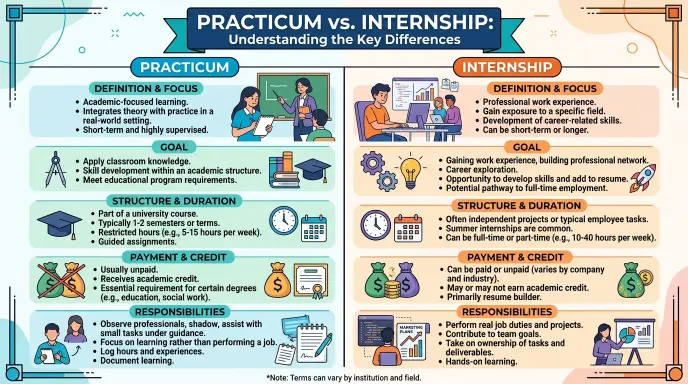
A practicum is usually a structured, supervised learning experience connected closely to an academic program, while an internship generally provides broader workplace experience and professional responsibilities. However, colleges and professions use these terms differently, so the official program requirements—not the label alone—determine the exact difference.
Key Takeaways
- A practicum is commonly tied directly to coursework, learning objectives, and close supervision.
- An internship generally emphasizes workplace experience, professional development, and greater responsibility.
- Both can provide hands-on experience, academic credit, and professional networking.
- Neither term automatically determines whether the experience is paid.
- The distinction varies significantly by college, degree, and profession.
What Is a Practicum?
A practicum is a supervised practical-learning experience where students apply concepts from their coursework in a real or professional setting. It is commonly built into an academic program and may have specific learning objectives, required hours, assignments, evaluations, and faculty oversight.
For example, a student studying education might spend time in a classroom working alongside an experienced teacher. A counseling student may practice professional skills under structured supervision. A public health student may complete a supervised field project with an organization.
The exact structure depends on the program. Boston University, for example, describes its public health practicum as a required graduate-level experience in which students apply classroom knowledge in a real-world public health setting under supervision.
Practicums are especially common in fields where students need supervised practice before taking on full professional responsibilities, including education, counseling, nursing, social work, and health-related programs.
How a Practicum Works
A typical practicum may involve:
- A placement at a school, clinic, nonprofit, agency, or other organization
- Specific learning objectives
- A faculty advisor or academic coordinator
- A site supervisor
- Required hours
- Reflection papers, assignments, or evaluations
- Academic credit or a course requirement
The important point is that a practicum is generally designed around learning and competency development, rather than simply placing a student into a temporary job.
What Is an Internship?
An internship is a temporary professional experience that gives a student or recent graduate an opportunity to work in a particular field. Internships can be connected to a college program, but they can also be pursued independently of academic coursework.
Interns may participate in ongoing organizational work, contribute to projects, attend meetings, develop professional skills, and interact with employees or clients. The amount of responsibility varies considerably by employer and industry.
Internships are common in business, technology, communications, engineering, government, healthcare, media, nonprofit organizations, and many other areas.
An internship may be full-time or part-time, paid or unpaid, depending on the arrangement and applicable rules. In the United States, whether an unpaid intern at a for-profit employer is legally considered an employee depends on the circumstances under the Fair Labor Standards Act; the U.S. Department of Labor describes a “primary beneficiary” analysis for evaluating these arrangements.
Practicum vs Internship: Key Differences
| Feature | Practicum | Internship |
|---|---|---|
| Main purpose | Academic learning and supervised practice | Professional and workplace experience |
| Academic connection | Usually strong | May or may not be connected to coursework |
| Supervision | Often close and structured | Usually workplace-focused, with oversight varying by program |
| Responsibilities | Often limited while skills develop | May involve broader professional responsibilities |
| Learning objectives | Usually explicit | May be formal or informal |
| Academic credit | Often available or required | May be available, depending on program |
| Pay | Often unpaid, but varies | May be paid or unpaid |
| Common settings | Education, counseling, health, social services | Business, technology, government, healthcare, media, and others |
| Terminology | Highly program-specific | Highly program-specific |
This table is a general comparison, not a universal rule. Some schools use “practicum” to describe an internship-like placement, while others make a clear distinction between the two.
For instance, Northwestern University describes its undergraduate practicum as an experiential-learning requirement containing both a full-time internship and an accompanying seminar. Case Western Reserve University similarly describes a practicum structure that can be built around an internship or entrepreneurial project.
Purpose and Structure
The biggest difference is often why the experience exists.
A practicum tends to be structured around applying academic theory and developing specific competencies. An internship tends to emphasize exposure to professional work and participation in an organization’s activities.
That distinction is useful, but it is not absolute.
Supervision
Practicums commonly involve close supervision because students are still developing foundational skills. An academic instructor, faculty advisor, licensed professional, or site supervisor may be involved.
Internships also involve supervision, but the structure can be more workplace-oriented. The intern may report primarily to a manager or professional at the host organization.
In some professions, both experiences have detailed supervision requirements.
Responsibilities and Independence
A practicum may begin with observation, guided practice, and limited responsibility. As students demonstrate competence, they may take on more complex tasks.
Internships can provide greater independence, but this is not guaranteed. A highly structured internship may involve substantial supervision, while an advanced practicum can involve meaningful professional work.
So it is better to think of level of responsibility as a program characteristic rather than a fixed definition.
Hours and Duration
There is no universal rule saying that every practicum has fewer hours than every internship.
The difference becomes particularly clear in professional programs with formal accreditation requirements. For example, CACREP standards for accredited counseling programs distinguish a supervised practicum from the subsequent internship. The standards specify a minimum practicum experience and then a substantially larger supervised internship experience.
In that setting, practicum comes before internship and develops foundational counseling skills, while internship builds on those skills through more extensive supervised fieldwork.
Academic Credit
Practicums are frequently integrated into courses or degree requirements. Students may need to register for a practicum course, complete assignments, document hours, and receive an evaluation.
Internships can also carry college credit. In fact, some schools use an internship as the practical component of a course or practicum requirement.
Therefore, academic credit alone does not tell you whether an experience is a practicum or internship.
Pay
Pay is another area where students should avoid simple assumptions.
Many traditional practicums are unpaid because their primary purpose is educational and they may be part of an academic program. However, a practicum is not automatically unpaid in every field or institution.
Internships may be paid or unpaid. The U.S. Department of Labor notes that unpaid internship arrangements at for-profit organizations must be evaluated under the applicable FLSA framework rather than simply being labeled “unpaid” by the employer.
Always check the specific program and employer terms before accepting a placement.
Are Practicum and Internship the Same Thing?
Not necessarily.
In some programs, they are clearly separate stages. In others, the words overlap or are used almost interchangeably.
The University of Hawaiʻi, for example, describes a practicum as a more directly supervised academic experience and an internship as a more job-oriented experience with greater responsibility.
But other universities use the terminology differently. Northwestern’s practicum includes an internship component, while Case Western Reserve University describes a practicum that can be based on an internship experience.
This means the safest answer is: read your school’s official course description, handbook, or degree requirements.
Practicum vs Internship by Field
The distinction can become clearer when you look at specific professions.
Counseling and Mental Health
Counseling provides one of the clearest examples of a formal practicum-to-internship progression.
Under CACREP standards, students complete practicum before internship. The 2024 standards specify at least 100 hours of supervised practicum, including at least 40 hours of direct service, followed by 600 hours of supervised internship, including at least 240 hours of direct service.
Here, practicum is the foundational stage, while internship provides more extensive professional field experience.
Education, Nursing, and Social Work
These fields frequently use supervised practical placements because students must connect classroom learning with professional practice.
For example, education programs may place students in schools under experienced teachers. Practicum experiences can allow students to observe, assist, and gradually take on professional tasks under supervision.
Business, Technology, and Other Fields
In business, technology, marketing, engineering, and similar fields, internship is generally the more familiar term.
An internship might involve software development, marketing campaigns, financial analysis, research, project management, or other work performed within an organization.
However, some universities may turn an internship into an academically structured practicum by adding learning objectives, faculty oversight, reflection assignments, or academic assessment.
Which Comes First: Practicum or Internship?
When a program formally distinguishes between the two, practicum often comes first.
This is especially clear in counseling education. CACREP defines practicum as an entry-level supervised experience for developing basic skills and internship as a post-practicum experience that refines and expands those skills.
But this sequence should not be generalized to every major. Some schools require an internship without a separate practicum, while others use the word practicum for the entire field experience.
How to Find Out What Your Program Requires
If you are deciding between a practicum and internship, look for these details in your school’s official documentation:
- Course description: Is the experience attached to a course?
- Required hours: How many hours must you complete?
- Supervision: Who evaluates or supervises your work?
- Academic credit: Do you receive credits or transcript recognition?
- Learning objectives: Does the program define specific competencies?
- Compensation: Is the placement paid, unpaid, or variable?
- Sequence: Does one experience have to be completed before another?
- Professional requirements: Does an accrediting or licensing body specify the placement?
These details are more reliable than the title of the experience alone.
Frequently Asked Questions
Is a practicum paid?
A practicum is often unpaid, particularly when it is primarily an academic requirement, but there is no universal rule that every practicum must be unpaid. Check the terms established by your school and placement site.
Does a practicum count as work experience?
Yes. A practicum can provide meaningful professional experience, particularly when it involves real responsibilities in a workplace setting. You can usually include relevant practicum experience on a resume, especially when it directly relates to the job you are seeking.
Are internships always paid?
No. Internships can be paid or unpaid. In the United States, unpaid internships at for-profit employers are subject to legal requirements under the Fair Labor Standards Act.
Can a practicum lead to a job?
Yes. A practicum can help students build professional skills, contacts, and familiarity with an industry. However, whether it leads to employment depends on the student, organization, available positions, and field.
Is a practicum required for graduation?
It depends on the academic program. Some degrees require a practicum or another supervised field experience, while others offer internships or experiential learning as alternatives.
Conclusion
The difference between practicum vs internship is mainly about structure, purpose, supervision, and how the academic program defines the experience.
A practicum is commonly a closely supervised academic field experience designed to help students apply theory and develop professional skills. An internship generally provides broader workplace exposure and may involve greater participation in an organization’s regular work.
However, there is no universal rule that makes every practicum shorter, unpaid, or less demanding than every internship. Universities and professional programs use these terms differently.
The best way to understand your own placement is to check its official requirements, including hours, supervision, academic credit, responsibilities, and compensation.