
If your dog has swallowed something harmful, you may quickly wonder how much hydrogen peroxide to give dogs by weight. Hydrogen peroxide has been used by veterinarians to induce vomiting in some dogs, but it is not a safe solution for every poisoning or every situation. The type of substance, amount swallowed, time since ingestion, and your dog’s health can all change what should happen next.
A common veterinary reference discusses using 3% hydrogen peroxide in dogs at a weight-based amount. However, that information should not be treated as a universal home-treatment formula. Giving the wrong amount, using a stronger product, or trying to make a dog vomit after certain toxic exposures can cause serious problems.
In this guide, we’ll explain the veterinary dosage reference, how weight affects it, when hydrogen peroxide may be unsafe, possible risks, and what to do if your dog eats something potentially toxic. When poisoning is suspected, contacting a veterinarian or pet poison professional should come first.
How Much Hydrogen Peroxide Can Dogs Have by Weight?
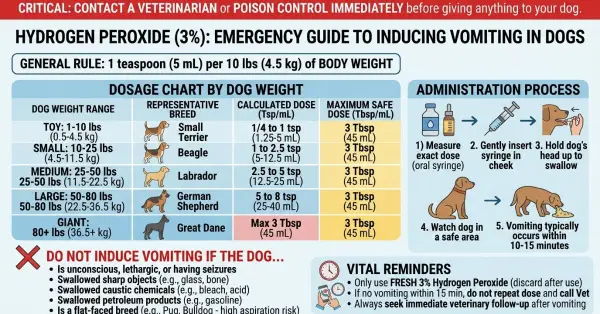
Veterinary references describe 3% hydrogen peroxide at 1–2 mL per kg of body weight, with a maximum amount of 45 mL. However, this range should be viewed as veterinary reference information, not as a universal instruction for treating your dog at home.
| Dog Weight | Reference Range for 3% Hydrogen Peroxide |
| 5 kg (11 lb) | 5–10 mL |
| 10 kg (22 lb) | 10–20 mL |
| 15 kg (33 lb) | 15–30 mL |
| 20 kg (44 lb) | 20–40 mL |
| 25 kg (55 lb) | 25–45 mL* |
| 30 kg (66 lb) | 30–45 mL* |
| 40 kg (88 lb) | 40–45 mL* |
*The published maximum is 45 mL.
The calculation may look simple, but deciding whether your dog should receive hydrogen peroxide is much more complicated. A veterinarian may need to know exactly what your dog swallowed, how much was consumed, and how long ago the exposure occurred.
Some substances should not be brought back up because vomiting can cause additional injury or increase the risk of aspiration. A dog that is unconscious, having seizures, struggling to breathe, or unable to swallow normally may also be at greater risk from attempted vomiting.
For this reason, do not use the table as a dosing calculator without professional advice. Call your veterinarian or a pet poison-control service first and provide your dog’s weight, the substance involved, the estimated amount, and the time of ingestion.
Why Your Dog’s Weight Is Not the Only Factor
Your dog’s weight is important when discussing a hydrogen peroxide dose, but it is only one part of the decision. The biggest question is what your dog swallowed. Different substances can require very different responses, and making a dog vomit can sometimes cause more harm than good.
The amount and timing of the exposure also matter. A veterinarian may need to know approximately how much was eaten and how long ago it happened. Some substances are absorbed quickly, while others may remain in the stomach longer. This information can help determine whether inducing vomiting could still be useful.
Your dog’s current condition matters, too. A healthy, alert dog that can swallow normally is very different from a dog that is weak, unconscious, having seizures, or having trouble breathing. In the latter situations, attempting to cause vomiting can increase the risk of aspiration.
Age and existing health problems may also affect the decision. Puppies, older dogs, and dogs with certain medical conditions may need additional caution.
This is why a simple hydrogen peroxide dosage by weight cannot tell you whether treatment is appropriate. Weight can help calculate a veterinary reference amount, but it does not determine the safest action by itself.
If your dog may have been poisoned, contact a veterinarian or animal poison-control professional before giving hydrogen peroxide. Have your dog’s weight, the product or substance involved, estimated amount, and time of ingestion ready. This information can help the professional make a safer recommendation for your specific situation.
What Type of Hydrogen Peroxide Is Used for Dogs?
Not all hydrogen peroxide products are the same. When veterinary references discuss using hydrogen peroxide to induce vomiting in dogs, they refer specifically to 3% hydrogen peroxide. The concentration is important because stronger solutions can cause serious irritation or injury to the mouth, throat, stomach, and other tissues.
A bottle labeled 3% contains a relatively dilute solution. You should never assume that a stronger product can be diluted or substituted safely without professional guidance. Hair developers, industrial products, and concentrated hydrogen peroxide may contain different strengths or additional ingredients that are not appropriate for use in dogs.
It is also important to check the product label before doing anything. Do not rely only on the appearance of the liquid or assume that every bottle called “hydrogen peroxide” has the same concentration.
Even when 3% hydrogen peroxide is available, it does not mean you should automatically give it to your dog. Whether inducing vomiting is appropriate depends on the substance swallowed, the amount, the timing, and your dog’s condition.
Using too much can increase the risk of stomach irritation, repeated vomiting, and other complications. There is also a risk of aspiration if vomited material enters the lungs.
If your dog has swallowed a potentially toxic substance, keep the product container or label available and contact your veterinarian or an animal poison-control professional. Tell them the exact product name and concentration, your dog’s weight, the estimated amount consumed, and when the ingestion occurred.
Never substitute a stronger peroxide product for 3% hydrogen peroxide based on a weight calculation.
How Hydrogen Peroxide Makes Dogs Vomit
Hydrogen peroxide can cause vomiting because it irritates the lining of a dog’s stomach. When 3% hydrogen peroxide reaches the stomach, it can produce bubbles and foam. This irritation may stimulate the vomiting reflex and cause the dog to bring up some of the stomach contents.
The goal, when vomiting is considered appropriate by a veterinary professional, is to remove some of the recently swallowed material before it is absorbed. However, vomiting does not guarantee that all of the harmful substances will be removed. Some toxins can be absorbed quickly, while others may cause injury even before vomiting occurs.
Hydrogen peroxide also has limitations. The same irritation that triggers vomiting can irritate the stomach and esophagus. Excessive vomiting may lead to additional problems, and foamy vomit can potentially be inhaled into the lungs. This is known as aspiration and can become a serious complication.
That is why making a dog vomit is not simply a matter of calculating a dose from body weight. The substance involved and your dog’s condition must be considered first. A veterinarian may decide that inducing vomiting is appropriate, recommend another treatment, or advise against vomiting altogether.
If your dog has swallowed a potentially dangerous substance, avoid experimenting with home remedies. Contact a veterinarian or animal poison-control professional and provide details about the substance, estimated amount, time of ingestion, and your dog’s weight.
Hydrogen peroxide is an emetic, not a universal treatment for poisoning. The safest approach is to get professional advice before using it.
What to Do If Your Dog Swallowed Something Toxic
If you think your dog has swallowed something toxic, stay calm and act quickly. The first step is to remove your dog from the substance so it cannot eat or lick more. Do not give food, milk, hydrogen peroxide, or another home remedy unless a veterinarian tells you to do so.
Next, try to identify exactly what your dog swallowed. Find the product container, packaging, ingredient list, or medication bottle. If you can safely do so, note the product name and concentration. This information can help a veterinarian decide what treatment may be appropriate.
Try to estimate how much your dog consumed and when the ingestion happened. You do not need to know the exact amount before calling for help. An approximate estimate is still useful. Also note whether your dog has already vomited or developed any unusual symptoms.
Contact your veterinarian, an emergency veterinary clinic, or an animal poison-control professional as soon as possible. Tell them your dog’s weight, age, the substance involved, estimated amount, time of ingestion, and current symptoms.
Do not assume that making your dog vomit is always the best option. Some chemicals, petroleum products, and other substances can cause additional injury when brought back up. Dogs that are unconscious, having seizures, struggling to breathe, or unable to swallow normally may also face a greater aspiration risk.
If your dog is showing severe symptoms, seek emergency veterinary care immediately. Acting quickly and providing accurate information is usually more helpful than trying several home treatments on your own.
What Information Will a Veterinarian Need?
When you call a veterinarian about possible poisoning, having the right information ready can make the conversation faster and more useful. You do not need to know every detail before making the call. Start with whatever information you have and let the veterinary professional guide you.
First, tell them your dog’s weight, age, and current condition. Mention any medical conditions or medications your dog takes, especially if your dog is already receiving treatment for another problem.
Next, provide details about the substance your dog may have swallowed. Give the exact product name if possible. Tell the veterinarian the estimated amount consumed and whether you know the product’s concentration or ingredients. Keep the original package, bottle, label, or medication container nearby so you can read the information accurately.
Timing is also important. Tell them approximately when the ingestion happened and whether your dog has eaten anything since then. Mention whether your dog has already vomited, and describe the vomit if anything unusual is present.
You should also report any symptoms, such as excessive drooling, repeated vomiting, weakness, shaking, coughing, breathing difficulty, seizures, or unusual behavior. Even if your dog appears normal, mention that too.
This information helps the veterinarian assess the exposure and determine whether inducing vomiting is appropriate. They may recommend monitoring, immediate examination, or another treatment instead of hydrogen peroxide.
Do not delay the call while trying to calculate a perfect hydrogen peroxide dose. Your dog’s weight is useful, but the complete exposure history is much more important for choosing a safe response.
Should You Make Your Dog Vomit at Home?
Making a dog vomit at home may sound like a quick solution after a suspected poisoning, but it is not always safe. Hydrogen peroxide should never be given simply because a dog has eaten something unusual. The substance involved and your dog’s condition must be considered first.
Veterinary professionals may sometimes recommend inducing vomiting when a dog has recently swallowed a substance that can safely be removed from the stomach. In other cases, vomiting can make the situation worse. For example, bringing corrosive chemicals back through the esophagus can cause additional tissue damage. There can also be a risk of aspiration, especially if the dog is weak, unconscious, having seizures, or having trouble swallowing.
This is why an online dosage chart cannot tell you whether your particular dog should receive hydrogen peroxide. Even if you know your dog’s weight and have 3% hydrogen peroxide available, professional advice is still important.
If your dog has swallowed something potentially toxic, contact your veterinarian, an emergency veterinary clinic, or an animal poison-control service. Give them the product name, ingredients or concentration, estimated amount swallowed, time of exposure, your dog’s weight, and any symptoms.
Do not try multiple home remedies while waiting for advice. Avoid giving additional substances unless a veterinary professional specifically recommends them.
The safest approach is simple: get professional guidance before inducing vomiting. A veterinarian can determine whether vomiting is appropriate or whether another treatment would be safer for your dog.
Possible Risks and Side Effects of Hydrogen Peroxide in Dogs
Hydrogen peroxide can cause vomiting, but it can also irritate a dog’s digestive system. This is why it should not be treated as a harmless home remedy. Even 3% hydrogen peroxide can cause problems when used in the wrong situation or amount.
One possible effect is stomach irritation. A dog may develop repeated vomiting, abdominal discomfort, drooling, or other digestive symptoms. Excessive vomiting can also contribute to dehydration and further irritation of the digestive tract.
Another serious concern is aspiration. This happens when vomit or other stomach contents enter the lungs instead of being safely expelled. Aspiration can lead to breathing problems and potentially serious pneumonia. The risk may be greater in dogs that are weak, unconscious, having seizures, or unable to swallow normally.
Using a stronger concentration than 3% can create additional risks. Concentrated hydrogen peroxide can damage tissues and should never be substituted for the veterinary reference concentration.
Giving more peroxide does not necessarily make vomiting safer or more effective. An excessive amount may increase irritation and complications. Repeated administration without professional instructions can also create unnecessary risk.
Watch your dog closely after any suspected poisoning or veterinary-directed treatment. Persistent vomiting, coughing, difficulty breathing, blood in vomit, severe weakness, collapse, or seizures require urgent veterinary attention.
If your dog has swallowed something potentially toxic, contact a veterinarian or animal poison-control professional before attempting to induce vomiting. They can determine whether hydrogen peroxide is appropriate and explain the safest next step based on the substance, amount, timing, and your dog’s condition.
When Is Dog Poisoning an Emergency?
Not every toxic exposure causes immediate symptoms, but some situations require urgent veterinary care. If you know or strongly suspect that your dog swallowed a dangerous substance, do not wait for signs of poisoning before seeking professional advice.
Get emergency veterinary help if your dog is having trouble breathing, experiencing seizures, collapsing, losing consciousness, or becoming severely weak. These signs can indicate a serious reaction and require prompt medical attention.
Repeated vomiting can also be concerning, especially if there is blood, severe abdominal discomfort, or unusual weakness. Excessive drooling, difficulty swallowing, tremors, confusion, or major changes in behavior should also be reported to a veterinarian.
Known ingestion of a potentially dangerous substance deserves attention even when your dog appears normal. Some toxins may cause delayed effects, while others can be absorbed before obvious symptoms develop. Waiting for your dog to become sick can therefore reduce the opportunity for early treatment.
When contacting a veterinarian, provide as much information as possible. Tell them your dog’s approximate weight, the product or substance involved, estimated amount, and time of ingestion. Keep the original packaging or label available if you have it.
If your dog is unconscious, having seizures, or struggling to breathe, do not attempt to make the dog vomit with hydrogen peroxide. These conditions can increase the danger of aspiration and require immediate professional care.
The key is to act quickly without experimenting with home remedies. A veterinarian can determine whether your dog needs immediate treatment, monitoring, or another response based on the specific toxin and your dog’s condition.
Can You Give Hydrogen Peroxide to Puppies or Senior Dogs?
Puppies and senior dogs may need extra care when dealing with possible poisoning. Their age can affect how they respond to illness, vomiting, dehydration, and certain treatments. For this reason, you should not assume that the same approach is suitable for every dog simply because the weight-based calculation appears similar.
Puppies are still developing, and their bodies can respond differently to toxic substances. They may also become dehydrated more quickly after repeated vomiting. Senior dogs may have underlying health problems or take medications that could affect treatment decisions. These factors make professional assessment especially important.
A dog’s weight can help a veterinarian understand the exposure, but it does not determine whether hydrogen peroxide should be used. The veterinarian will also consider what was swallowed, how much was consumed, when the exposure occurred, and whether the dog has developed symptoms.
If a puppy or older dog has swallowed something potentially toxic, contact your veterinarian or an animal poison-control professional as soon as possible. Provide the dog’s weight, age, medical history if known, product information, estimated amount swallowed, and time of ingestion.
Do not give hydrogen peroxide simply because your dog falls within a particular weight range. Age, health, and the type of substance involved can change the safest course of action.
If the dog is unconscious, having seizures, struggling to breathe, collapsing, or unable to swallow normally, seek emergency veterinary care immediately rather than attempting to induce vomiting at home.
Hydrogen Peroxide vs. Veterinary Treatment
Hydrogen peroxide is only one possible option when a dog swallows something harmful. It should never be viewed as a complete treatment for poisoning. Depending on the substance involved, a veterinarian may recommend a different approach that is safer and more effective.
A veterinary professional can first determine whether inducing vomiting is appropriate. If it is not, they may use another treatment based on the specific toxin and your dog’s condition. In some cases, treatment may include activated charcoal, fluids, medications, oxygen support, or careful monitoring. The exact treatment depends on the substance, amount, timing, and symptoms.
A veterinary clinic also provides an important advantage: your dog can be monitored for complications. This matters because some poisonings can cause delayed symptoms even when a dog initially appears normal. A professional can watch for changes in breathing, heart rate, neurological function, hydration, and other important signs.
If hydrogen peroxide has already been given, tell the veterinarian exactly what concentration was used and approximately how much your dog received. Do not hide this information, even if you are worried that you used too much. It can help the veterinary team make safer treatment decisions.
Most importantly, do not delay professional care while trying multiple home remedies. Hydrogen peroxide may be appropriate in selected circumstances, but veterinary treatment is often the safer choice when poisoning is suspected.
When in doubt, contact a veterinarian or animal poison-control professional promptly and follow their instructions rather than relying on a weight-based peroxide calculation alone.
Common Mistakes Dog Owners Make
When a dog eats something harmful, it is easy to panic and act quickly. Unfortunately, some common home-treatment mistakes can make the situation worse. Knowing what to avoid can help you respond more safely.
One common mistake is calculating a hydrogen peroxide dose from weight alone. Your dog’s weight matters, but it does not tell you whether vomiting is appropriate. The substance swallowed, amount, timing, and your dog’s condition also need to be considered.
Another mistake is using the wrong concentration. Veterinary references discuss 3% hydrogen peroxide, not concentrated peroxide products. Using a stronger product can increase the risk of injury.
Some owners also give additional doses when their dog does not vomit quickly. This can increase stomach irritation and other complications. Do not repeat hydrogen peroxide unless a veterinary professional specifically instructs you to do so.
It is also risky to induce vomiting after certain exposures. Corrosive chemicals, petroleum-based products, and some other substances can cause additional injury when brought back up. Dogs that are unconscious, having seizures, struggling to breathe, or unable to swallow normally may also face a higher aspiration risk.
Another mistake is waiting for symptoms before seeking help. Some toxins can cause delayed problems, so a dog that appears normal may still need professional assessment.
Finally, avoid experimenting with salt, mustard, oils, or other household remedies. These methods can create additional risks without treating the underlying poisoning.
If your dog may have swallowed something toxic, contact a veterinarian or animal poison-control professional promptly. Give them your dog’s weight, the substance involved, estimated amount, time of ingestion, and current symptoms.
Frequently Asked Questions
1. How do you make stone in Little Alchemy 1?
In Little Alchemy 1, you can make Stone by combining Air + Lava. This creates Stone, which can then be used to discover many other elements.
2. How do you make pressure in Little Alchemy 2?
In Little Alchemy 2, Pressure can be created by combining Earth + Earth. Pressure is useful for making several other elements as you continue exploring combinations.
3. How do you make life in Little Alchemy 2?
To make Life in Little Alchemy 2, combine Energy + Swamp. Life is an important element because it can be used to create several living things.
4. How do you make a gun in Little Alchemy 2?
You can make Gun in Little Alchemy 2 by combining Metal + Bullet. You first need to create the required elements before making the final combination.
5. How do you make metal in Little Alchemy 2?
In Little Alchemy 2, you can make Metal by combining Fire + Stone. Metal is a useful basic element for creating many advanced items.
6. How do you make sand in Little Alchemy?
In Little Alchemy, Sand can be made by combining Air + Stone. Sand can then be combined with other elements to unlock new discoveries.
7. How do you make rock in Little Alchemy 2?
To make Rock in Little Alchemy 2, combine Air + Lava. Rock is one of the useful elements that can help you create more complex items.
8. How do you make a human in Little Alchemy?
In Little Alchemy, you can make a Human by combining Earth + Life. You first need to create Life and then combine it with Earth to unlock Human.
Final Takeaway: Weight Is Only One Piece of the Puzzle
Knowing how much hydrogen peroxide to give dogs by weight can be useful for understanding veterinary dosing references, but weight should never be the only factor used to decide what to give your dog. A published veterinary reference for dogs uses 3% hydrogen peroxide at 1–2 mL/kg, with a maximum of 45 mL. However, this does not mean every dog or poisoning should be treated with hydrogen peroxide.
The substance your dog swallowed matters just as much. Some chemicals, petroleum products, medications, and corrosive substances can make vomiting dangerous. Your dog’s age, health, symptoms, swallowing ability, and risk of aspiration also need to be considered.
If your dog may have eaten something toxic, remove the substance and keep its packaging. Try to determine what was swallowed, approximately how much was eaten, and when it happened. Then contact your veterinarian or an animal poison-control service for instructions.
Never substitute stronger hydrogen peroxide for 3% hydrogen peroxide, and do not repeatedly give doses because your dog has not vomited. Too much hydrogen peroxide can irritate the stomach and may cause serious complications.
Most importantly, do not rely on a simple weight calculator during a poisoning emergency. A veterinarian can determine whether inducing vomiting is appropriate and recommend safer treatment when it is not.
When in doubt, call a veterinary professional before giving hydrogen peroxide. Fast, informed action is safer than guessing the dose or trying multiple home remedies.