
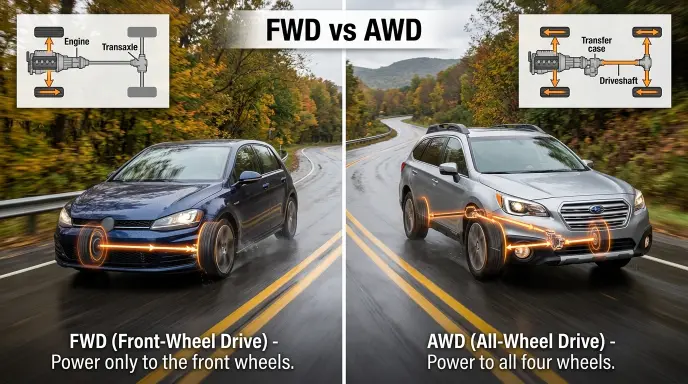
FWD vs AWD mainly comes down to how power reaches the wheels. FWD, or front-wheel drive, sends engine power to the front wheels and is usually lighter, less expensive, and more fuel-efficient. AWD, or all-wheel drive, can send power to both front and rear wheels for added traction. FWD works well for most everyday driving, while AWD is especially useful for frequent snow, slippery roads, hills, and loose surfaces.
Key Takeaways
- FWD powers the front wheels and is usually the simpler, more economical option.
- AWD can distribute power to both axles to improve traction during acceleration.
- AWD can be helpful in snow, rain, gravel, and slippery conditions, but it does not eliminate the need for good tires.
- FWD generally has an advantage in fuel economy and purchase cost, although the difference varies by vehicle.
- For most drivers who stay on paved roads, FWD is enough. AWD becomes more valuable when extra traction is regularly useful.
What Is FWD?
FWD stands for front-wheel drive. In an FWD vehicle, the engine or electric motor sends driving force to the front wheels. Those same wheels are responsible for both pulling the vehicle forward and steering it.
FWD is extremely common in modern cars, sedans, hatchbacks, minivans, and crossover SUVs. Its layout can be relatively compact because many major drivetrain components are located toward the front of the vehicle.
For everyday driving, FWD can be a practical choice. It typically provides predictable handling, good traction during normal road use, and competitive fuel economy.
How Front-Wheel Drive Works
When you press the accelerator, power travels through the transmission and differential to the front wheels. Because the front tires are doing the driving and steering, tire condition is particularly important.
FWD can also perform reasonably well in light snow when equipped with appropriate tires. However, the drivetrain itself does not make a vehicle immune to slippery conditions.
Benefits of FWD
Common advantages include:
- Lower purchase price on many comparable vehicles
- Good fuel economy
- Relatively simple drivetrain packaging
- Good everyday road manners
- Useful traction for normal paved-road driving
- Often lower operating costs
The exact advantages depend on the vehicle. Modern hybrid and electric drivetrains can change the traditional FWD-versus-AWD fuel-economy equation.
What Is AWD?
AWD stands for all-wheel drive. An AWD system can deliver driving force to both the front and rear axles. However, not every AWD system works in exactly the same way.
Some systems operate with power going to both axles regularly. Others normally operate primarily through one axle and send torque to the other when additional traction is needed. Subaru, for example, describes AWD systems that can distribute varying amounts of torque between axles, while other manufacturers use on-demand systems.
That means you should not assume that every AWD vehicle behaves identically.
How All-Wheel Drive Works
AWD uses additional drivetrain hardware or electric motors to provide power to more than one axle. Sensors and electronic controls can monitor wheel speed and other conditions and adjust torque delivery.
The main advantage is straightforward: more driven wheels can provide more opportunities to maintain traction when accelerating on a slippery surface.
That can be especially useful when starting on snow, climbing a wet hill, leaving a gravel road, or driving over a loose surface.
Benefits of AWD
AWD may be useful for drivers who:
- Regularly drive in snow
- Live in areas with frequent winter storms
- Travel on gravel or loose surfaces
- Drive on steep or slippery roads
- Want additional acceleration traction
- Frequently use an SUV or crossover beyond paved roads
Still, AWD is not a substitute for appropriate tires or careful driving.
FWD vs AWD: Key Differences
| Feature | FWD | AWD |
|---|---|---|
| Driven wheels | Front wheels | Front and rear axles |
| Normal-road use | Excellent | Excellent |
| Slippery-road acceleration | Good | Generally better |
| Snow capability | Good with proper tires | Better traction when accelerating |
| Fuel economy | Usually better | Usually somewhat lower |
| Purchase cost | Usually lower | Usually higher |
| Drivetrain complexity | Lower | Higher |
| Maintenance potential | Generally simpler | Can be more complex |
| Light off-road use | Limited | Better suited |
| Best for | Everyday paved-road driving | Mixed conditions and extra traction |
These are general tendencies, not guarantees. Vehicle design, tires, weight, powertrain technology, and the specific AWD system can change the result.
FWD vs AWD: Traction and Acceleration
This is where AWD has its clearest advantage.
When a road is slippery, distributing driving force across more wheels can help reduce wheelspin during acceleration. That can make an AWD vehicle easier to get moving on snow, wet pavement, gravel, or a steep slippery road.
However, AWD does not magically create grip. Every tire still has a limited amount of traction available.
This distinction matters because drivers sometimes assume AWD improves every aspect of winter performance. It does not.
FWD vs AWD: Fuel Economy
FWD usually has a fuel-economy advantage because the vehicle may have less drivetrain hardware and less weight to move.
However, the difference is not universal. Modern AWD systems can be highly efficient, especially when they disconnect or reduce power to an axle when extra traction is unnecessary.
For example, Toyota’s current Corolla Cross gas models show the typical pattern: the FWD version is rated at 31/33/32 mpg city/highway/combined, while the AWD version is rated at 29/31/30 mpg.
Toyota’s 2026 Camry also shows that the exact difference varies by trim and powertrain. Its FWD LE is rated at 52/49/51 mpg city/highway/combined, while an AWD SE is rated at 46/46/46 mpg.
So if maximum fuel economy is your priority, compare the exact FWD and AWD versions rather than relying only on the drivetrain label.
FWD vs AWD in Snow and Ice
If you frequently drive in snowy areas, AWD can make acceleration easier. It can help distribute power when one or more wheels begin to lose traction.
But there is an important catch: AWD does not improve braking in the same way it improves acceleration.
Michelin explains that AWD and 4WD can help a vehicle accelerate on snow, but braking and cornering depend heavily on the tires. It recommends winter tires on all four wheels for regular snow, ice, and freezing conditions.
That means a well-equipped FWD vehicle with quality winter tires can be a better winter-driving choice than an AWD vehicle running poor or worn tires.
NHTSA also emphasizes the importance of choosing tires appropriate for conditions and notes that winter tires are more effective than all-season tires in deep snow.
FWD vs AWD in Rain
Both FWD and AWD vehicles can handle rain safely when driven appropriately.
AWD can provide an advantage when accelerating on a wet surface because power can be distributed across more wheels. This can be helpful when pulling away from a stop or climbing a wet incline.
However, AWD does not mean you can drive faster in heavy rain.
Tires remain critical. Wet-road traction depends on the tires’ condition, tread, and compound. NHTSA notes that tire traction ratings relate specifically to stopping performance on wet pavement.
Therefore, slow down when conditions require it, maintain a safe following distance, and avoid sudden steering or braking inputs.
FWD vs AWD for Daily Driving
For a driver who mainly commutes through a city or travels on paved highways, FWD is often the better value.
You may not need the additional drivetrain hardware if your roads are normally dry and well maintained. FWD can provide good everyday traction while keeping the vehicle relatively efficient and affordable.
AWD makes more sense when your normal routine includes conditions where extra traction has real value.
For example:
Choose FWD if you mostly:
- Commute on paved roads
- Drive in mild weather
- Want better fuel economy
- Want to keep the purchase price lower
- Rarely encounter snow or loose surfaces
Consider AWD if you regularly:
- Drive through snowy winters
- Travel on steep roads
- Encounter gravel or loose surfaces
- Drive to mountain or outdoor destinations
- Need additional traction when accelerating
FWD vs AWD for SUVs and Off-Road Use
AWD can be particularly attractive in crossovers and SUVs because these vehicles are often used for a wider range of road conditions.
Still, AWD does not automatically turn a crossover into a serious off-road vehicle.
Ground clearance, suspension, tires, approach and departure angles, traction-control programming, and vehicle construction all matter. A dedicated 4WD vehicle may be more appropriate for demanding off-road environments.
AWD is generally best viewed as a traction system, not proof that a vehicle is built for extreme off-roading.
Is AWD Safer Than FWD?
Not automatically.
AWD can improve acceleration traction, especially when the road is slippery. That can make the vehicle feel more confident when pulling away.
But safety involves much more than acceleration.
Braking, cornering, tires, vehicle stability systems, road conditions, speed, and driver behavior all matter. AWD cannot overcome the physical limits of a tire’s grip.
This is why the idea that “AWD is always safer” is too simple. In winter conditions, a properly equipped FWD vehicle with suitable tires can perform extremely well.
FWD vs AWD Pros and Cons
FWD Pros
- Usually lower cost
- Generally better fuel economy
- Simpler drivetrain
- Excellent for normal paved roads
- Good choice for many commuters
FWD Cons
- Less acceleration traction on some slippery surfaces
- More limited for loose or difficult terrain
- Can struggle more when climbing certain slippery roads
AWD Pros
- Better acceleration traction in many slippery conditions
- Useful in snow, rain, gravel, and loose surfaces
- Good choice for drivers who regularly encounter changing road conditions
- Can provide additional confidence in poor weather
AWD Cons
- Often costs more to buy
- Can consume more fuel
- Adds drivetrain complexity
- May increase tire or service costs depending on the vehicle
- Does not improve braking simply because all wheels can receive power
Which Should You Choose?
For most drivers, the answer is simple: choose FWD if your driving is primarily on normal paved roads and choose AWD if you regularly need extra traction.
FWD is usually the sensible option for city commuters, highway drivers, and buyers who prioritize price and fuel economy.
AWD is worth considering if you live in a snowy region, regularly drive steep or slippery roads, or frequently travel on gravel and other loose surfaces.
Before deciding, compare the exact vehicle versions. Look at EPA fuel-economy ratings, tire sizes, ground clearance, purchase price, maintenance requirements, and the manufacturer’s description of the AWD system.
Most importantly, do not overlook tires. AWD can help a vehicle accelerate, but it does not replace good tires or safe winter-driving habits.
Frequently Asked Questions
Is FWD better than AWD?
Neither is universally better. FWD is usually better for buyers who want lower cost, good fuel economy, and reliable everyday performance on paved roads. AWD is better suited to drivers who regularly encounter snow, slippery roads, steep surfaces, or loose terrain.
Is AWD worth the extra money?
AWD can be worth the extra cost if you frequently need additional traction. If you rarely encounter snow, steep roads, or loose surfaces, FWD may provide better value. Compare the exact purchase price, fuel economy, tires, and maintenance costs before deciding.
Is FWD or AWD better in snow?
AWD generally provides better acceleration traction in snow because it can send power to both axles. However, tires are extremely important. Winter tires can make a major difference in braking, cornering, and overall control. AWD should not be treated as a replacement for proper winter tires.
Does AWD use more gas than FWD?
Usually, an AWD version of the same vehicle uses somewhat more fuel than its FWD counterpart because of additional drivetrain components and, in some designs, added weight. However, modern systems can reduce this difference, so always check the EPA rating for the specific model.
Does AWD help with braking?
No. AWD primarily helps with delivering power during acceleration. It does not automatically give a vehicle shorter stopping distances on snow or ice. Tire grip is critical for braking, which is why appropriate winter tires are so important.
Is AWD the same as 4WD?
No. AWD and 4WD are related but different drivetrain approaches. AWD is commonly designed for automatic traction management on roads and mixed surfaces, while many 4WD systems are designed with more dedicated off-road capability. The exact hardware and terminology vary by manufacturer.
Conclusion
Choosing between FWD vs AWD depends on your driving habits, weather, budget, and road conditions. FWD is usually the better choice for everyday driving because it can offer lower costs, good fuel economy, and reliable performance on paved roads. For most commuters, city drivers, and highway travelers, FWD provides everything they need.
AWD becomes more valuable when extra traction is a regular part of your driving. If you frequently deal with snow, steep roads, heavy rain, gravel, or other slippery surfaces, AWD can provide better acceleration traction and added confidence behind the wheel.
However, AWD is not automatically safer or better in every situation. Your tires, driving speed, road conditions, and vehicle design all play an important role. Before choosing, compare the exact FWD and AWD versions of the vehicle you want and consider how often you will actually use the additional traction.
In short, choose FWD for simplicity, efficiency, and everyday value; choose AWD when you regularly need extra traction. The right drivetrain is the one that matches your real-world driving needs.