
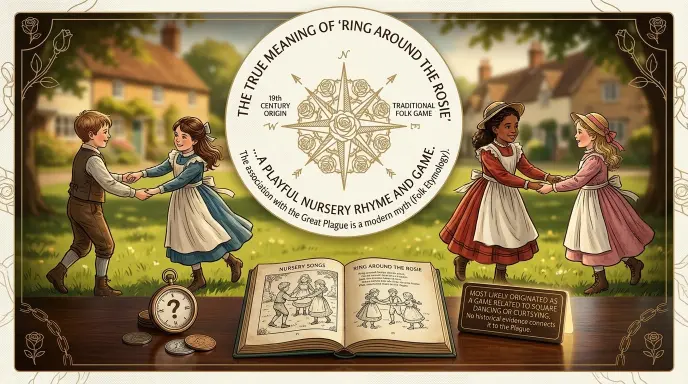
If you grew up singing “Ring Around the Rosie,” you may have heard a strange story about it: the rhyme supposedly describes the bubonic plague. That story sounds convincing because the words mention flowers, falling down, and death-like images.
But the real history is more interesting.
The ring around the rosie meaning is not proven to be a hidden description of the plague. The Library of Congress notes that the plague explanation is a popular piece of folklore, but researchers have found no solid evidence that the rhyme began as a plague song.
So what does the rhyme mean? In its most practical sense, it is a children’s singing game. Kids join hands, move in a circle, sing the rhyme, and fall down at the end. Older versions and related forms appeared in different places, which makes the rhyme’s history harder to trace than the famous plague story suggests.
This guide explains the Ring Around the Rosie meaning, its lyrics, origin, game, plague myth, and why the rhyme still matters today.
Quick Answer: What Does Ring Around the Rosie Mean?
Ring Around the Rosie is a traditional children’s rhyme and circle game. Children hold hands, move around in a circle, sing the rhyme, and usually fall down together at the final line.
The popular idea that the rhyme describes the Black Death or bubonic plague is not supported by strong historical evidence. The Library of Congress specifically describes the plague explanation as folklore and says it is probably not true.
The exact meaning of every old phrase is also uncertain. Traditional rhymes often changed as people passed them from one generation to another.
In short, the safest answer is:
Ring Around the Rosie is a children’s singing game with many traditional versions. Its supposed plague meaning is a later interpretation, not a proven historical origin.
Ring Around the Rosie Meaning in Simple Words
The rhyme works more like a game instruction than a story with a clear plot.
Children form a ring and move around together. The words describe things such as a “ring,” flowers or posies, and then everyone falls down.
A common American version includes:
“Ring around the rosie / Pocket full of posies / Ashes, ashes / We all fall down!”
The final action gives the rhyme its playful structure. Everyone waits for the last words and then drops to the ground.
That is important because it helps explain why the rhyme became so popular with children. It is not only something to recite. It tells children what to do while they sing.
The Library of Congress describes songs such as this as singing games, because they combine words, music, movement, and shared rules.
What Does “Rosie” Mean?
The word “rosie” is often connected with the idea of a rose or a rosy circle.
However, there is no single proven explanation for every word in the rhyme.
Some versions use wording that differs from the familiar American version. Traditional children’s songs often change over time as children hear, remember, and repeat them.
That means it is risky to assign one exact dictionary-style meaning to every line.
The phrase may sound as if it describes a person named Rosie, but the traditional rhyme does not clearly establish a character named Rosie. In many versions, the language works more as playful rhyme than as a detailed story.
This is one reason the Ring Around the Rosie lyrics meaning can be confusing when people try to decode each word as if it were a historical report.
What Does “Pocket Full of Posies” Mean?
A posy is a small bunch or bouquet of flowers.
So a “pocket full of posies” simply creates an image of carrying flowers.
This line often gets connected to the plague theory because people sometimes claim that flowers were carried to protect people from disease or bad smells.
That interpretation sounds plausible when placed next to the plague story, but plausibility is not proof.
The Library of Congress’s research into the rhyme warns against treating the plague explanation as established history. The institution discusses the story as a form of metafolklore, or folklore about folklore.
In other words, people have told a story about what the rhyme supposedly means, and that story itself became part of popular folklore.
Is Ring Around the Rosie About the Plague?
Probably not.
This is the biggest question people ask about the rhyme.
The famous theory says:
- The “rosie” represents a rash.
- The “posies” represent flowers carried during the plague.
- “Ashes” represents burning bodies or cremation.
- “We all fall down” represents death.
It makes for a memorable story.
The problem is the lack of strong historical evidence connecting the rhyme to the plague.
The Library of Congress directly examines this claim and concludes that the plague origin story is probably false.
That does not mean the plague theory came from nowhere. It became a widely repeated explanation because people noticed possible connections between the words and historical disease.
But a connection made long after a rhyme existed is different from proof of its original meaning.
Plague Myth vs. Better-Supported View
| Popular Plague Interpretation | Better-Supported Historical View |
|---|---|
| “Rosie” describes a plague rash | The exact meaning is uncertain |
| Posies were used to fight plague | Flowers appear in versions, but this does not prove a plague connection |
| “Ashes” means bodies were burned | The line has several possible interpretations |
| Falling down means people died | Falling down is also the central action of the children’s game |
| The rhyme began during the Black Death | No strong evidence proves this origin |
| The whole rhyme is a secret plague song | Researchers treat this as folklore rather than established history |
The key lesson is simple: a rhyme can resemble a historical event without being created to describe that event.
Where Did Ring Around the Rosie Come From?
The exact origin remains uncertain.
That may sound frustrating, but it is actually common with traditional children’s rhymes.
Unlike a modern song, a traditional rhyme may not have one known writer, one original manuscript, or one official first version. People pass it by word of mouth. Different communities can change words, sounds, and actions.
The rhyme has also appeared in historical records and photographs showing children playing it.
For example, the Library of Congress holds a photograph of children playing “ring around a rosie” in Lynn, Massachusetts, dated around 1895.
The Library of Congress also has a 1941 photograph showing children playing the game in Chicago.
These records help establish something important: the rhyme was a real children’s game in American life long before the modern internet spread the plague explanation.
The Library of Congress also maintains recordings and collections of children’s songs, including versions of “Ring Around Rosey.”
Why Are There Different Versions?
You may notice that one person sings:
“Ring around the rosie…”
while another uses a slightly different ending or wording.
That happens because traditional rhymes evolve.
Children often learn these songs by hearing them from parents, teachers, siblings, or other children. When a rhyme moves from one place to another, people may change words to match local speech or make the rhyme easier to remember.
Different versions may also use:
- Different opening words
- Different words for flowers
- Different sounds in the final line
- Different actions
- Different numbers of repetitions
There is no need to assume that one version must be “wrong.”
Traditional folklore often survives through variation.
How the Ring Around the Rosie Game Works
The game itself helps explain the rhyme better than the plague theory does.
A simple version works like this:
- Several children stand together.
- Everyone holds hands.
- The group forms a circle.
- The children walk around the circle.
- They sing the rhyme.
- Everyone falls down at the final words.
The falling part is especially important.
If you look at the rhyme as a children’s activity, “falling down” does not need a dark explanation. It is the fun payoff at the end of the game.
Children’s singing games often use movement as part of the song. The Library of Congress describes this connection between songs, movements, and game rules in its discussion of children’s folklore.
Ring Around the Rosie Lyrics Meaning
People often search for the Ring Around the Rosie lyrics meaning because the words seem mysterious.
The common American version uses images such as:
- A ring or circle
- A rosie
- Posies
- Ashes
- Falling down
These words create a simple rhyme that supports the actions of the game.
The important point is that not every line needs to carry a hidden historical message.
Children’s rhymes often use repetition, rhyme, silly images, and simple actions. A phrase may survive because it sounds good and works well during play.
That is a better fit for this rhyme than forcing every word into a plague-related explanation.
Why the Plague Theory Became So Popular
The plague story has several features that make it easy to remember.
First, the rhyme contains words that can be connected to illness or death if someone interprets them that way.
Second, the rhyme is very old in popular memory, so people naturally wonder whether it records an event from the past.
Third, the explanation creates a dramatic contrast. A cheerful children’s song suddenly becomes a dark historical story.
That contrast makes the theory memorable.
But memorable stories are not always accurate stories.
This is a useful lesson when researching folklore in general. A claim can appear on many websites and still lack reliable historical support.
The Library of Congress’s treatment of Ring Around the Rosie is especially useful because its folklorists directly discuss and evaluate the plague claim rather than simply repeating it.
What “We All Fall Down” Really Does in the Game
The final action is one of the strongest clues about how the rhyme functions as a game.
The children move together while singing. Then everyone falls at the same time.
That creates a predictable ending.
For a young child, this is simple and fun. The group moves, waits, sings, and then performs the same action together.
So while “fall down” can sound frightening when separated from the game, it has a very ordinary meaning within the activity: the game ends when everyone falls down.
This does not prove the rhyme’s original meaning. But it shows why there is no need to interpret the line as a reference to death.
Is Ring Around the Rosie Still Popular?
Yes. The rhyme remains recognizable as a children’s song and game.
Historical records show children playing it in the United States more than a century ago. The Library of Congress has also collected field recordings and other materials involving children’s songs and games, including “Ring Around Rosey.”
Its survival makes sense.
The rhyme is:
- Easy to remember
- Easy to sing
- Easy to play
- Suitable for groups
- Built around movement
- Fun for young children
Those qualities help children’s songs survive even when their original history becomes unclear.
Ring Around the Rosie Meaning: Common Mistakes to Avoid
When researching this rhyme, the biggest mistake is treating the plague theory as settled fact.
Another mistake is assuming that every traditional rhyme has one exact original meaning.
Folklore does not always work that way.
| Mistake | Better Approach |
|---|---|
| Saying the rhyme definitely describes the plague | Say the plague theory is popular but unsupported |
| Treating every word as a medical symbol | Consider the rhyme as a children’s singing game |
| Claiming one version is the only original version | Recognize that traditional rhymes have variants |
| Assuming “fall down” means death | Consider its role as the game’s final action |
| Repeating internet claims as historical facts | Check reliable folklore and archival sources |
| Giving a certain origin when evidence is unclear | Clearly separate evidence from interpretation |
Being honest about uncertainty makes the explanation stronger, not weaker.
Quick Reference: Ring Around the Rosie
| Question | Short Answer |
|---|---|
| What is it? | A traditional children’s rhyme and singing game |
| What does “rosie” mean? | Its exact traditional meaning is uncertain |
| What is a posy? | A small bunch or bouquet of flowers |
| Is it about the plague? | There is no strong evidence proving that |
| Why do children fall down? | Falling is part of the game’s action |
| Does it have one original version? | No single version can be treated as certain |
| Why is it still known? | It is simple, rhythmic, social, and easy to play |
Why This Rhyme Matters in Folklore
Ring Around the Rosie is more than an old children’s song.
It shows how folklore changes as people pass it along.
A child may learn a rhyme without knowing who created it. Years later, an adult may hear a theory about its meaning. That theory gets repeated. Eventually, people may remember the explanation more strongly than the original evidence.
That process is exactly why folklore researchers study not only old songs but also the stories people tell about those songs.
The Library of Congress calls this kind of discussion metafolklore. Its researchers use “Ring Around the Rosie” as an example of how explanations about folklore can become folklore themselves.
That makes the rhyme a useful example of how cultural memory works.
Does the Rhyme Have a Dark Meaning?
Not necessarily.
The rhyme can feel dark if you hear the plague interpretation first. Once someone tells you that every line represents disease and death, the words may sound completely different.
But without that interpretation, the song works as a simple group game.
That distinction matters.
There is a difference between:
“This rhyme has a dark interpretation.”
and
“This rhyme was created to describe a dark historical event.”
The first statement is fair.
The second requires evidence.
For Ring Around the Rosie, the available evidence does not justify treating the plague story as a proven origin.
What Parents and Teachers Can Tell Kids
If a child asks whether Ring Around the Rosie is about the plague, you do not need to give a complicated history lesson.
A simple answer works:
“Some people think it is about the plague, but historians have not found good evidence for that. It is best known as an old children’s singing game.”
That answer teaches two useful ideas at once.
First, it explains the rhyme.
Second, it teaches children that a popular story is not automatically a proven fact.
For older children, you can go one step further and explain that traditional songs can change over time. That makes the topic a fun introduction to folklore, history, and source checking.
FAQs About Ring Around the Rosie Meaning
1. What is the true meaning of Ring Around the Rosie?
The safest answer is that it is a traditional children’s singing game. Children form a circle, sing the rhyme, and fall down at the end. Its exact original meaning remains uncertain.
2. Is Ring Around the Rosie really about the plague?
There is no strong historical evidence proving that. The Library of Congress describes the plague explanation as folklore and says the story is probably not true.
3. What does “pocket full of posies” mean?
A posy means a small bunch or bouquet of flowers. The phrase creates a simple flower image within the rhyme. It does not, by itself, prove a connection to the plague.
4. Why does everyone fall down in Ring Around the Rosie?
Falling down is part of the traditional game. Children move around in a circle while singing and then fall together at the ending.
5. Who wrote Ring Around the Rosie?
There is no securely established single author for the traditional children’s rhyme. It belongs to a broader tradition of folk songs and children’s games that changed through oral use.
6. Why are there different Ring Around the Rosie lyrics?
Traditional songs often develop different versions as people pass them from one generation or place to another. Words, endings, and actions can change while the basic game remains recognizable.
7. Why do people think Ring Around the Rosie is about death?
The idea comes from interpreting words such as “rosie,” “posies,” “ashes,” and “fall down” as references to disease and death. That interpretation became popular, but researchers have not found strong evidence that this was the rhyme’s original meaning.
Conclusion
The Ring Around the Rosie meaning is simpler—and more uncertain—than the famous plague story suggests. The rhyme is best understood as a traditional children’s singing game in which children move in a circle and fall down together at the end.
The plague explanation remains a popular piece of folklore, but the Library of Congress says there is no good reason to treat it as a proven origin.
If you hear someone repeat the plague story, you do not have to call it completely meaningless. Instead, call it what the evidence supports: a fascinating folklore theory, not established history. That small distinction gives you a much more accurate understanding of this familiar childhood rhyme.