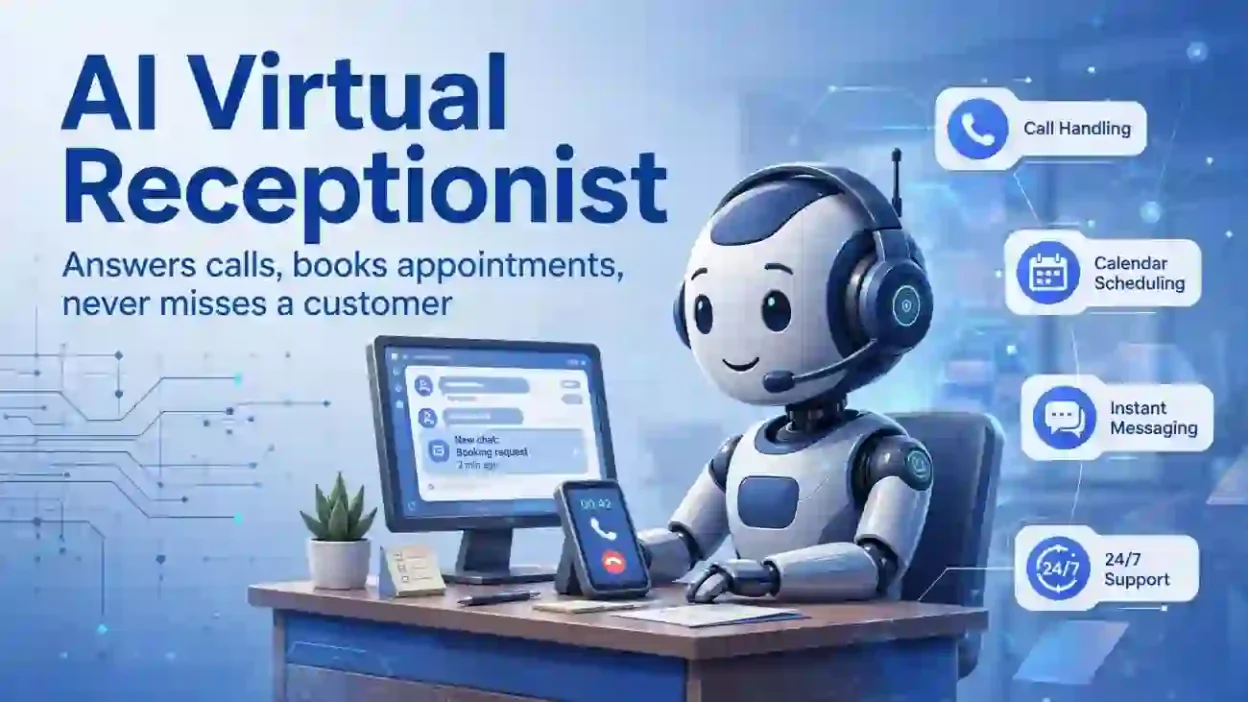
An AI virtual receptionist is an AI-powered assistant that answers business calls, responds to common questions, schedules appointments, and routes callers to the right person. It helps businesses manage customer inquiries around the clock, reduce missed calls, and improve response times without requiring a full-time human receptionist.
Key Takeaways
- An AI virtual receptionist answers incoming calls and assists customers using artificial intelligence.
- Small businesses can use it to manage calls, book appointments, and capture leads.
- Many AI receptionists operate 24/7, including after business hours.
- Features, pricing, integrations, and voice quality vary between providers.
- Human staff remain important for sensitive, complex, or unusual customer requests.
AI Virtual Receptionist
Introduction
Missing a phone call can mean losing a customer. For small businesses, medical offices, law firms, home service companies, and other organizations, answering every call while managing daily tasks can be difficult.
An AI virtual receptionist offers a practical way to handle incoming calls without relying entirely on a human receptionist. It uses artificial intelligence to understand callers, answer common questions, collect information, schedule appointments, and transfer calls when needed.
Businesses are increasingly interested in this technology because customers expect quick answers and convenient service. At the same time, hiring additional staff can increase operating costs.
In this guide, you will learn what an AI virtual receptionist is, how it works, which features matter, and how businesses can use one effectively. You will also discover its benefits, limitations, typical costs, and the questions to ask before choosing a provider.
What Does “AI Virtual Receptionist” Mean?
An AI virtual receptionist is a software-based assistant that manages incoming business calls through an AI-powered voice system. Unlike a traditional answering service, it can understand spoken questions and respond based on its instructions, connected business information, and available tools.
For example, a customer might call a dental office to ask about appointment availability. The AI receptionist can collect the customer’s details, check an integrated scheduling system if supported, and help arrange a visit.
Common uses include:
- Answering frequently asked questions.
- Scheduling, confirming, or rescheduling appointments.
- Collecting customer contact information.
- Qualifying sales leads.
- Routing callers to the correct department.
- Providing business hours, directions, and service details.
- Handling calls outside regular business hours.
AI receptionists are used across industries such as healthcare, real estate, legal services, retail, hospitality, and home services. Their exact capabilities depend on the software, integrations, and rules established by each business.
Why Use an AI Virtual Receptionist?
Businesses use AI receptionists to make phone communication more reliable while allowing employees to focus on other responsibilities.
Here are the main advantages:
- Reduce missed calls: Answer more incoming calls when staff members are busy.
- Provide after-hours support: Help callers when the office is closed, if the service operates continuously.
- Save staff time: Automate routine questions and basic administrative tasks.
- Improve lead capture: Collect names, phone numbers, and service requests from potential customers.
- Simplify appointment management: Connect callers with available booking options.
- Support consistent service: Give callers approved information using a defined response process.
However, automation is not the right answer for every conversation. Businesses should provide a clear way to reach a human when callers need personal attention, complex assistance, or an exception to standard procedures.
10 Best Other Ways to Say “AI Virtual Receptionist”
The following alternatives describe related technologies and services. They are not always exact synonyms, so choose the phrase that accurately reflects what the product does.
1. AI Receptionist
Meaning
An AI receptionist is a digital assistant that uses artificial intelligence to manage routine receptionist duties. It can answer calls, respond to common questions, and help direct customers.
Best For:
Professional, Casual, Friendly
Example 1:
Our AI receptionist answers customer calls while the team works with clients.
Example 2:
We added an AI receptionist to handle common questions about our services.
Quick Tip:
Use this shorter term when discussing the technology generally or introducing it to potential customers.
2. Virtual Receptionist Service
Meaning
A virtual receptionist service provides remote call-handling support for a business. Depending on the provider, the service may use human receptionists, AI technology, or a combination of both.
Best For:
Professional, Formal, Polite
Example 1:
Our virtual receptionist service manages incoming calls during busy periods.
Example 2:
The company selected a virtual receptionist service to improve its customer response process.
Quick Tip:
Check whether the service uses AI, human agents, or both before describing it as automated.
3. Automated Receptionist
Meaning
An automated receptionist handles routine communication through software and predefined workflows. It may use voice recognition, interactive menus, or conversational AI to assist callers.
Best For:
Professional, Formal
Example 1:
The automated receptionist directs billing questions to the correct department.
Example 2:
We configured an automated receptionist to share holiday hours with callers.
Quick Tip:
Choose this phrase when emphasizing automation rather than conversational intelligence.
4. AI Phone Assistant
Meaning
An AI phone assistant uses voice technology to communicate with callers and complete supported phone tasks. Depending on its features, it can answer questions, collect information, and help schedule appointments.
Best For:
Professional, Casual, Friendly
Example 1:
Our AI phone assistant collects basic information before transferring sales calls.
Example 2:
Customers can ask our AI phone assistant about available service appointments.
Quick Tip:
This term works well when the software performs several phone-related tasks beyond traditional reception.
5. AI-Powered Answering Service
Meaning
An AI-powered answering service uses artificial intelligence to respond to incoming calls and manage routine customer inquiries. It may also capture messages, qualify leads, or route calls.
Best For:
Professional, Formal
Example 1:
The plumbing company uses an AI-powered answering service to capture emergency repair requests.
Example 2:
Our AI-powered answering service records caller details when the office is closed.
Quick Tip:
Use this phrase when answering-service functionality is the main selling point.
6. Virtual Phone Assistant
Meaning
A virtual phone assistant helps manage business phone communication remotely through software. Depending on its capabilities, it may answer questions, organize messages, and connect callers with employees.
Best For:
Professional, Casual, Friendly
Example 1:
The virtual phone assistant helps our small team manage incoming customer questions.
Example 2:
We use a virtual phone assistant to organize calls from new clients.
Quick Tip:
This broader term suits products that handle several communication tasks, not just front-desk duties.
7. Conversational AI Receptionist
Meaning
A conversational AI receptionist uses natural-language technology to interact with callers in a more flexible way than a basic phone menu. It can respond to different questions within the limits of its training, instructions, and integrations.
Best For:
Professional, Formal
Example 1:
The conversational AI receptionist answers questions about our appointment policies.
Example 2:
We introduced a conversational AI receptionist to make phone interactions easier for customers.
Quick Tip:
Use this phrase when natural conversation is a key feature of the system.
8. Digital Receptionist
Meaning
A digital receptionist is a software-based assistant that performs selected front-desk tasks. It may manage phone calls, website inquiries, appointment requests, or other customer interactions.
Best For:
Professional, Friendly, Casual
Example 1:
Our digital receptionist helps visitors find the information they need before arriving.
Example 2:
The digital receptionist collects appointment requests from customers throughout the day.
Quick Tip:
Choose this phrase when the system supports more than voice calls.
9. 24/7 AI Answering Assistant
Meaning
A 24/7 AI answering assistant is designed to respond to calls at any time of day or night. It can help businesses capture inquiries outside normal working hours when continuous service is included in the plan.
Best For:
Professional, Casual, Friendly
Example 1:
Our 24/7 AI answering assistant records new service requests overnight.
Example 2:
Customers can contact the business through its 24/7 AI answering assistant on weekends.
Quick Tip:
Only use “24/7” if the service is actually available around the clock.
10. Intelligent Call-Handling Assistant
Meaning
An intelligent call-handling assistant uses software and AI to manage incoming calls according to business rules. It can identify a caller’s needs, collect relevant details, and route the call to the appropriate destination.
Best For:
Professional, Formal
Example 1:
The intelligent call-handling assistant directs urgent requests to the on-call employee.
Example 2:
Our intelligent call-handling assistant separates appointment inquiries from billing questions.
Quick Tip:
Use this phrase when routing calls and organizing inquiries are more important than booking appointments.
Comparison Table
| Alternative | Best Used In | Tone |
|---|---|---|
| AI receptionist | General business communication | Professional, friendly |
| Virtual receptionist service | Service descriptions and proposals | Formal, polite |
| Automated receptionist | Technical explanations | Professional, formal |
| AI phone assistant | Product pages and marketing | Friendly, professional |
| AI-powered answering service | Business service descriptions | Professional, formal |
| Virtual phone assistant | General communication tools | Casual, professional |
| Conversational AI receptionist | AI technology discussions | Professional, formal |
| Digital receptionist | Multichannel customer support | Friendly, professional |
| 24/7 AI answering assistant | After-hours call services | Friendly, professional |
| Intelligent call-handling assistant | Call routing and workflows | Professional, formal |
Common Mistakes
Choosing the right terminology helps businesses set clear expectations. Avoid these five common mistakes when describing an AI virtual receptionist.
1. Treating every service as fully automated. Some virtual receptionist providers use human agents or hybrid teams. Explain which tasks AI performs and which require staff.
2. Promising features the software does not support. Do not claim that a receptionist can book appointments, process payments, or integrate with a CRM unless those features are available and properly configured.
3. Confusing an AI receptionist with a basic phone menu. A traditional interactive voice response system follows menu options, while a conversational AI receptionist may understand more flexible spoken requests. Actual capabilities vary.
4. Ignoring privacy and security. Calls may contain personal or confidential information. Review data retention, recording consent, access controls, and applicable privacy requirements before deployment.
5. Removing human support entirely. AI can struggle with unusual questions, unclear speech, and emotionally sensitive situations. Provide an easy escalation path for callers who need a person.
Frequently Asked Questions
1. What is an AI virtual receptionist?
An AI virtual receptionist is an AI-powered system that answers business phone calls and handles routine customer requests. Depending on the software, it can answer frequently asked questions, schedule appointments, collect contact details, and transfer calls. Businesses use it to improve call coverage and reduce the workload on employees.
2. How does an AI virtual receptionist work?
An AI virtual receptionist typically combines speech recognition, language-processing technology, and voice generation. It interprets what a caller says, determines an appropriate response, and speaks back to the caller. When connected to business tools, it may also check schedules, record information, or route calls according to configured rules.
3. How much does an AI virtual receptionist cost?
Pricing varies by provider, features, and call volume. Some services charge a monthly subscription, while others use per-minute pricing, usage allowances, or additional fees for integrations and advanced features. Compare the total expected monthly cost, including overage charges and setup fees, rather than choosing a plan based on its advertised starting price alone.
4. Is an AI virtual receptionist suitable for small businesses?
Yes. An AI virtual receptionist can help small businesses that receive more calls than their staff can answer consistently. Contractors, salons, consultants, and local service companies may use it to capture leads and manage appointments. The best fit depends on call volume, customer expectations, available integrations, and the need for human assistance.
5. Can an AI virtual receptionist book appointments?
Many AI receptionists can schedule appointments when they have access to a compatible calendar or booking system. Depending on the integration, they may check availability, collect customer details, and confirm a booking. Businesses should test the complete process to ensure that appointments are recorded correctly and that the system does not promise unavailable time slots.
6. Can an AI receptionist answer calls 24/7?
Many AI receptionist services are designed to operate around the clock. This allows customers to ask questions, leave details, or submit service requests after business hours. However, availability depends on the provider’s plan and technical setup. Calls requiring a human response may still need an on-call employee or an alternative contact method.
7. Is an AI virtual receptionist better than a human receptionist?
Neither option is ideal for every situation. AI can handle routine questions consistently and manage many calls without a conventional front-desk schedule, while human receptionists can use judgment, empathy, and flexible problem-solving. Some businesses benefit from a hybrid approach in which AI manages common requests and staff handle complex or sensitive conversations.
8. What should I look for when choosing an AI virtual receptionist?
Look for reliable call handling, natural-sounding speech, accurate responses, clear pricing, and useful integrations with your calendar or CRM. Check whether the service supports call transfers, after-hours coverage, reporting, and human escalation. Also review privacy safeguards, recording policies, language support, and the process for updating business information.
Conclusion
An AI virtual receptionist can help businesses answer calls, manage appointments, collect leads, and provide customer support with less manual effort. For small businesses, it offers a practical way to improve phone coverage without immediately hiring additional front-desk staff.
The right solution depends on your business needs. Choose an AI receptionist for general-purpose call assistance, an AI-powered answering service when capturing incoming inquiries is the priority, or a conversational AI receptionist when customers need to ask questions in their own words.
Before choosing a provider, review its features, integrations, pricing, privacy protections, and ability to transfer callers to a human. Test common questions and difficult scenarios before relying on the system for important customer interactions.