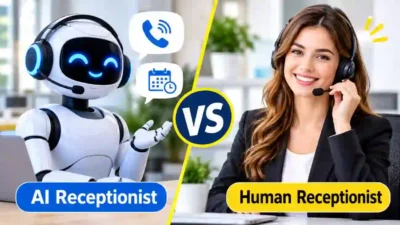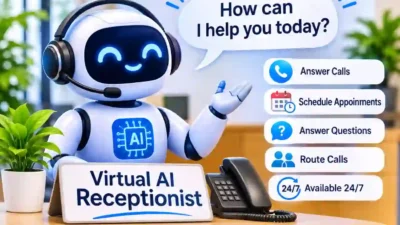
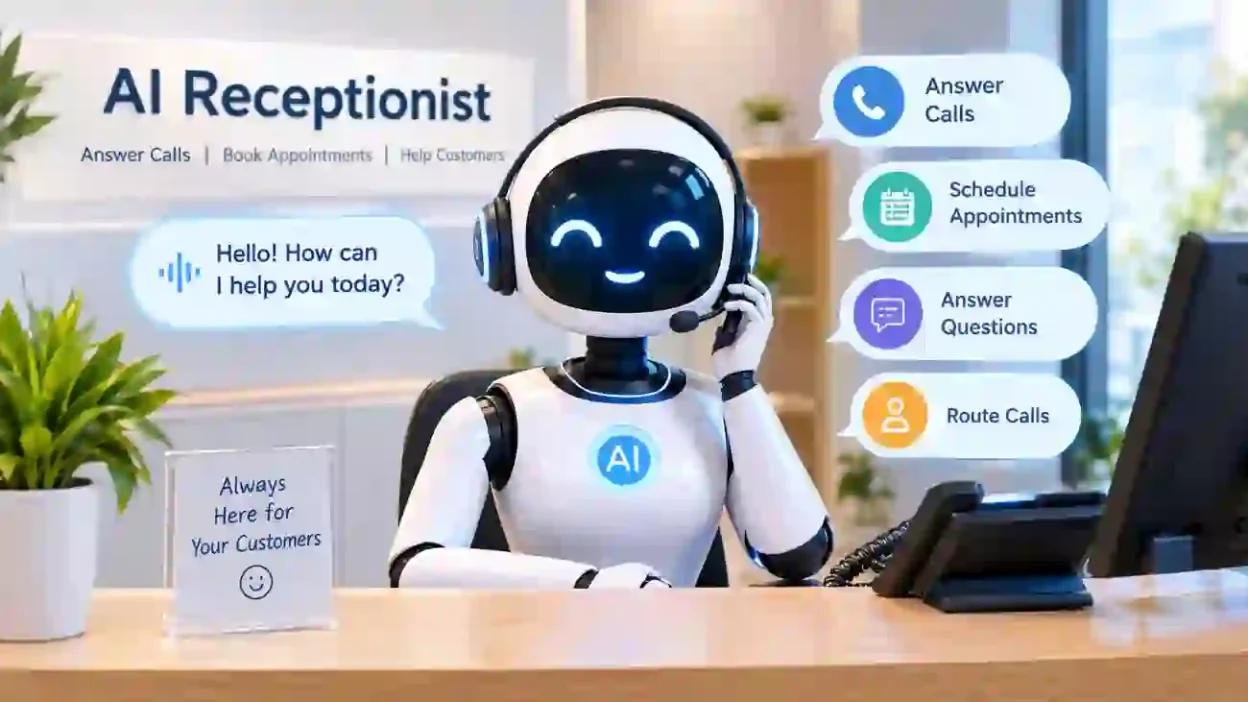
An AI receptionist is a virtual assistant that uses artificial intelligence to answer business calls, respond to common questions, schedule appointments, and route callers to the right person. Businesses use AI receptionists to handle calls around the clock, reduce missed opportunities, improve customer service, and manage routine phone tasks without relying entirely on a human receptionist.
Key Takeaways
– An AI receptionist answers incoming calls and handles routine customer requests automatically.
– Small businesses can use it to capture leads, schedule appointments, and answer calls after hours.
– AI receptionists can reduce repetitive work, but pricing and savings depend on the provider and call volume.
– Useful features include natural-sounding voice conversations, call transfers, CRM integration, and appointment booking.
– Human support remains important for complex questions, sensitive situations, and callers who need personal assistance.
AI Receptionist
Introduction
Missing a business call can mean losing a customer, an appointment, or a valuable sales opportunity. However, answering every call is not always possible when you are helping customers, working with clients, or managing daily operations.
An AI receptionist offers a practical way to manage incoming calls without requiring someone to answer every conversation personally. It uses artificial intelligence to greet callers, understand their requests, provide basic information, and complete routine tasks.
This technology is becoming useful for small businesses, medical offices, law firms, home service companies, real estate agencies, and other organizations that depend on phone communication. Depending on the system, it may also book appointments, collect contact details, transfer calls, and send follow-up messages.
In this guide, you will learn how an AI receptionist works, why businesses use one, which features matter most, and how to choose a solution that fits your needs. You will also discover common mistakes to avoid before adopting this technology.
What Does “AI Receptionist” Mean?
An AI receptionist is software that uses artificial intelligence to manage phone calls and perform tasks traditionally handled by a front-desk receptionist. It can listen to callers, interpret their questions, and respond using a conversational voice.
Unlike a basic voicemail system, an AI receptionist can often hold a two-way conversation. Depending on its capabilities, it may answer frequently asked questions, schedule appointments, collect customer information, and connect callers with employees.
Businesses commonly use this technology in healthcare offices, salons, repair companies, consulting firms, and other service-based industries. Some systems handle incoming calls only, while others also make outbound calls, send reminders, and update customer relationship management (CRM) software.
Why Use Other Ways to Say “AI Receptionist”?
The term AI receptionist is useful, but it does not describe every system accurately. Some tools focus on answering calls, while others specialize in scheduling, customer support, or lead management.
Using a more specific term can help you explain the service clearly, compare providers, and communicate its benefits to potential customers.
Here are a few reasons to use alternative terms:
– Improve clarity: Explain exactly what the software does.
– Target the right audience: Match the terminology to your industry.
– Support SEO: Address related search terms naturally in website content.
– Set expectations: Distinguish a simple answering service from a full virtual assistant.
– Improve sales conversations: Describe the features that matter most to prospective customers.
10 Best Other Ways to Say “AI Receptionist”
The following alternatives describe related technologies and services. They are not always interchangeable, so choose the term that accurately represents the system you offer.
1. Virtual Receptionist
Meaning
A virtual receptionist handles front-desk tasks remotely through software, a human service, or a combination of both. When AI powers the service, it can answer calls, greet customers, and manage routine requests automatically.
Best For: Professional, Friendly, Formal
Example 1: Our virtual receptionist answers customer calls and schedules consultations throughout the day.
Example 2: A virtual receptionist helps our small team stay available even when everyone is busy.
Quick Tip: Use this term when describing a remote receptionist service without making the technology the main selling point.
2. AI Answering Service
Meaning
An AI answering service automatically answers incoming business calls and responds to common customer questions. It may also collect messages, identify callers, and forward urgent requests.
Best For: Professional, Formal, Polite
Example 1: We introduced an AI answering service to manage customer calls after business hours.
Example 2: Our AI answering service collects caller details before sending qualified leads to the sales team.
Quick Tip: Choose this phrase when your main goal is to explain how a business handles incoming calls.
3. Automated Receptionist
Meaning
An automated receptionist uses technology to manage common front-desk duties with limited human involvement. Depending on the system, it may rely on AI conversations, predefined workflows, or both.
Best For: Professional, Formal
Example 1: The automated receptionist gives new patients basic information about our office.
Example 2: We installed an automated receptionist to reduce the time employees spend answering routine questions.
Quick Tip: Use this phrase when emphasizing efficiency and automation rather than advanced conversational features.
4. AI Phone Assistant
Meaning
An AI phone assistant communicates with callers and helps complete tasks through spoken conversations. It may answer questions, gather information, transfer calls, or connect with other business tools.
Best For: Professional, Friendly, Casual
Example 1: Our AI phone assistant helps customers find available appointment times without waiting on hold.
Example 2: The AI phone assistant collects project details before connecting callers with our service manager.
Quick Tip: This term works well when the system does more than greet callers or take messages.
5. AI Call Answering Assistant
Meaning
An AI call answering assistant focuses on receiving calls and responding to callers automatically. It can help businesses handle busy periods, reduce unanswered calls, and maintain consistent communication.
Best For: Professional, Formal, Polite
Example 1: We use an AI call answering assistant to manage incoming inquiries during peak hours.
Example 2: The AI call answering assistant records customer requests and routes urgent calls to our team.
Quick Tip: Use this descriptive phrase when explaining the service to customers who may not recognize the term AI receptionist.
6. Virtual Phone Assistant
Meaning
A virtual phone assistant uses software to manage phone-based tasks for a business. Depending on its features, it may handle conversations, provide business information, schedule meetings, or transfer calls.
Best For: Professional, Friendly, Casual
Example 1: Our virtual phone assistant helps callers reach the right department without unnecessary transfers.
Example 2: A virtual phone assistant gives our remote team a more organized way to manage customer inquiries.
Quick Tip: Choose this term when phone communication is the main focus of your service.
7. AI Voice Agent
Meaning
An AI voice agent uses speech recognition, language processing, and voice generation to interact with people. It can follow conversational requests and complete supported tasks rather than simply playing recorded messages.
Best For: Professional, Formal
Example 1: Our AI voice agent confirms appointments and answers common questions about service availability.
Example 2: The company uses an AI voice agent to qualify incoming leads before a salesperson follows up.
Quick Tip: Use this term for more advanced systems that can understand requests and take actions during conversations.
8. Automated Call Management System
Meaning
An automated call management system organizes incoming calls through features such as routing, answering, call queues, and message handling. Some systems include conversational AI, while others rely on menus and predefined rules.
Best For: Professional, Formal
Example 1: Our automated call management system directs billing questions to the appropriate department.
Example 2: The new call management system helps our support team organize inquiries during busy periods.
Quick Tip: Use this phrase when discussing the wider phone system rather than only its AI receptionist feature.
9. AI Customer Service Assistant
Meaning
An AI customer service assistant helps customers obtain information and resolve routine issues. It may work through phone calls, website chat, messaging platforms, or a combination of channels.
Best For: Professional, Friendly, Warm
Example 1: Our AI customer service assistant explains return procedures and answers basic product questions.
Example 2: The AI customer service assistant helps customers check appointment details before contacting our office.
Quick Tip: Choose this term when customer support extends beyond answering and routing telephone calls.
10. Intelligent Virtual Assistant
Meaning
An intelligent virtual assistant uses AI to understand requests and perform supported tasks with minimal manual input. It can assist with scheduling, information retrieval, customer communication, and other workflows.
Best For: Professional, Formal
Example 1: Our intelligent virtual assistant helps manage meeting requests and routine customer inquiries.
Example 2: The firm uses an intelligent virtual assistant to gather information before an initial consultation.
Quick Tip: This broader term suits systems that manage several tasks beyond receptionist duties.
Comparison Table
Alternative Best Used In Tone
Virtual Receptionist General business services Friendly, professional
AI Answering Service Incoming call handling Formal, practical
Automated Receptionist Routine front-desk tasks Professional
AI Phone Assistant Interactive phone support Friendly, professional
AI Call Answering Assistant Call answering and routing Clear, formal
Virtual Phone Assistant Phone-based business tasks Casual, professional
AI Voice Agent Conversational automation Technical, professional
Automated Call Management System Business phone operations Formal, technical
AI Customer Service Assistant Customer support Friendly, helpful
Intelligent Virtual Assistant Multiple automated tasks Formal, technical
Common Mistakes
Choosing the wrong term can confuse customers or create unrealistic expectations. Avoid these five mistakes when describing an AI receptionist.
1. Using a casual phrase in formal business content. Terms such as phone helper may sound unclear or unprofessional. Use established descriptions such as AI answering service or virtual receptionist.
2. Treating every term as identical. A call routing system may not understand natural speech, and a customer service assistant may work across several channels. Explain the actual capabilities.
3. Repeating the same keyword excessively. Using AI receptionist in every paragraph can make content sound unnatural. Include relevant alternatives where they improve clarity.
4. Ignoring the intended audience. Technical buyers may understand AI voice agent, while a local salon owner may prefer virtual receptionist. Match your language to your readers.
5. Making unsupported promises. Do not claim that an AI system handles every call perfectly or eliminates all staffing costs. Explain its limitations, integrations, and escalation options honestly.
Frequently Asked Questions
1. What is another name for an AI receptionist?
Common alternatives include virtual receptionist, AI answering service, automated receptionist, AI phone assistant, and AI voice agent. The best choice depends on the system’s capabilities. For example, an AI answering service emphasizes incoming calls, while an AI voice agent highlights conversational automation and task completion.
2. How does an AI receptionist work?
An AI receptionist typically uses speech recognition to understand callers, an AI model to interpret requests, and a generated voice to respond. It follows configured rules and integrations to answer questions, schedule appointments, or transfer calls. Its performance depends on the quality of its setup, available information, and supported features.
3. Is an AI receptionist the same as a virtual receptionist?
Not always. A virtual receptionist can be a human working remotely, an automated system, or a combination of both. An AI receptionist specifically uses artificial intelligence to handle conversations and tasks. Check the provider’s service description to understand whether calls are handled by AI, people, or both.
4. Can an AI receptionist book appointments?
Yes, many AI receptionists can schedule appointments when connected to a supported calendar or booking platform. They may check available time slots, collect customer details, and confirm bookings. However, features vary by provider, so verify calendar compatibility, rescheduling options, cancellation handling, and confirmation messages before choosing a service.
5. Is an AI receptionist suitable for small businesses?
An AI receptionist can be useful for small businesses that receive regular calls but cannot always answer them immediately. Salons, contractors, consultants, and other service providers may use one to capture leads and schedule appointments. The value depends on call volume, subscription costs, integration needs, and the importance of personal customer interaction.
6. Can an AI receptionist answer calls after hours?
Many AI receptionist services operate outside normal business hours, including evenings and weekends. They can answer common questions, record information, and handle supported booking requests. Before subscribing, confirm the provider’s availability, usage limits, emergency call procedures, and options for forwarding urgent requests to a human.
7. How much does an AI receptionist cost?
Pricing varies by provider, features, and monthly call volume. Some services charge a fixed subscription, while others use per-minute pricing, usage tiers, or additional fees for integrations and advanced features. Compare total expected costs, overage charges, setup fees, and contract terms rather than choosing a service based on its advertised starting price alone.
8. What should I look for when choosing an AI receptionist?
Look for natural conversations, accurate answers, reliable call transfers, appointment scheduling, and integrations with your existing tools. Also review data protection practices, call recording policies, pricing limits, and support availability. Test the system with realistic customer questions and confirm that callers can reach a human when the AI cannot resolve their needs.
Conclusion
An AI receptionist can help businesses answer calls, manage appointments, capture leads, and provide information without requiring an employee to handle every routine request. The right terminology makes it easier to explain these benefits and helps potential customers understand what a service actually offers.
For general business communication, virtual receptionist is a familiar and flexible option. Choose AI answering service when incoming calls are your main focus, AI voice agent when conversational automation is central, or AI customer service assistant when the system supports a broader range of customer interactions.
Before choosing a service, compare its features, integrations, pricing, privacy protections, and ability to transfer complex requests to a human. Remember that not every automated phone system offers the same level of intelligence or functionality.
The most helpful approach is to select the phrase that accurately describes your technology, then support it with clear examples of the tasks your system can perform.