
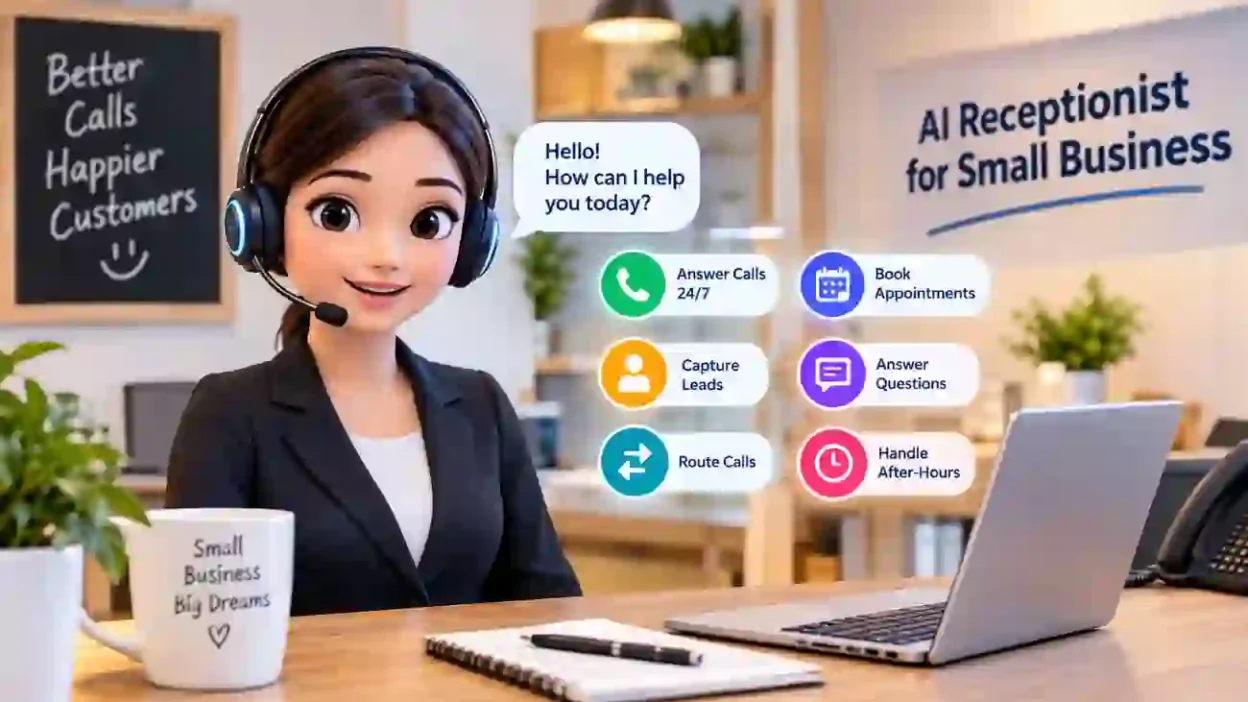
An AI receptionist for small business is a virtual assistant that answers phone calls, responds to common questions, collects customer information, and schedules appointments automatically. It helps small businesses manage calls during business hours and after closing, reduce missed opportunities, and provide consistent customer service without hiring a full-time receptionist.
Key Takeaways
An AI receptionist answers incoming calls automatically and assists customers around the clock.
Small businesses can use it to book appointments, capture leads, and answer routine questions.
It can reduce interruptions and help teams focus on important work.
The best solution depends on call volume, budget, integrations, and business needs.
Human support remains important for complex questions, complaints, and sensitive situations.
AI Receptionist for Small Business
Introduction
Running a small business often means handling several jobs at once. You might be serving customers, managing employees, scheduling appointments, and answering phone calls throughout the day. When calls arrive at the wrong time, you may miss important questions, new leads, or potential sales.
An AI receptionist for small business can help solve this problem by answering calls, sharing basic information, and handling routine tasks automatically. Unlike a traditional receptionist, an AI-powered system can often manage multiple calls and remain available outside normal business hours, depending on its plan and configuration.
Many business owners explore these tools because they want reliable phone coverage without adding another full-time employee. However, not every service offers the same features or pricing.
This guide explains how AI receptionists work, why small businesses use them, which features matter most, and how to choose a solution that fits your needs.
What Does “AI Receptionist for Small Business” Mean?
An AI receptionist for small business is software that uses artificial intelligence and voice technology to communicate with callers. It can greet customers, understand spoken questions, provide approved answers, and complete specific tasks based on the business’s instructions.
For example, a plumbing company could use an AI receptionist to collect a caller’s location, understand the type of repair needed, and forward urgent requests to the right person. A salon could use one to answer questions about opening hours and help customers schedule appointments.
These systems are commonly used by service businesses, medical offices, real estate agencies, law firms, home repair companies, and other small organizations that receive regular phone calls.
The exact capabilities depend on the provider. Some systems mainly answer and forward calls, while others support appointment booking, customer relationship management (CRM) integrations, and automated follow-ups.
Why Use an AI Receptionist for Small Business?
A small business may not need a full-time receptionist, but it still needs a reliable way to respond to customers. AI receptionists can fill that gap by managing routine conversations and helping staff stay productive.
Common benefits include:
Fewer missed calls: Answer incoming calls when employees are busy.
Extended availability: Handle inquiries after closing when configured for round-the-clock service.
Better productivity: Reduce interruptions caused by routine phone questions.
Lead collection: Capture names, phone numbers, and details about potential customers.
Appointment management: Schedule, confirm, or change bookings when supported.
Consistent service: Give callers clear, approved information about your business.
Flexible coverage: Handle recurring call patterns without requiring a staff member to answer every call.
However, an AI receptionist is not automatically cheaper or better than a human receptionist in every situation. Businesses should compare the total cost, the quality of conversations, and the need for human assistance before choosing a service.
10 Best Other Ways to Say “AI Receptionist for Small Business”
The following alternatives describe related tools and services. They are not always exact technical synonyms, so choose the phrase that accurately describes the solution you offer or need.
1. Virtual Receptionist for Small Business
Meaning
A virtual receptionist handles front-desk duties remotely rather than working at your physical location. The service may use AI software, human receptionists, or a combination of both.
Best For
Professional, Formal
Example 1
“Our virtual receptionist for small business helps manage incoming calls while our technicians work on-site.”
Example 2
“We are considering a virtual receptionist to provide better phone coverage without expanding our office space.”
Quick Tip
Use this phrase when discussing remote receptionist services, especially if the service includes human support.
2. AI Phone Answering Service
Meaning
An AI phone answering service uses automated voice technology to answer calls and respond to common requests. Its main purpose is to ensure callers receive a response rather than reaching voicemail.
Best For
Professional, Casual
Example 1
“Our AI phone answering service collects customer details whenever the office team is unavailable.”
Example 2
“The repair shop introduced an AI phone answering service to manage calls during busy afternoons.”
Quick Tip
Choose this term when your main priority is answering incoming calls rather than managing every front-desk task.
3. Automated Receptionist
Meaning
An automated receptionist handles selected receptionist duties through software. Depending on the system, it may use voice menus, conversational AI, or predefined workflows.
Best For
Formal, Professional
Example 1
“The company installed an automated receptionist to direct callers to the appropriate department.”
Example 2
“Our automated receptionist shares office hours and basic service information with new customers.”
Quick Tip
This is a useful general term, but explain whether the system uses conversational AI or traditional phone menus.
4. Virtual Phone Assistant
Meaning
A virtual phone assistant helps manage phone conversations without requiring an employee to handle every call. It may answer questions, organize messages, or route callers to the correct person.
Best For
Friendly, Professional
Example 1
“Our virtual phone assistant helps customers reach the right team without unnecessary transfers.”
Example 2
“I use a virtual phone assistant to keep track of customer inquiries while working on projects.”
Quick Tip
Use this phrase when you want to emphasize everyday phone support rather than a complete front-desk replacement.
5. AI Call Answering Assistant
Meaning
An AI call answering assistant uses voice recognition and language processing to understand callers and provide relevant responses. It can also gather information or transfer calls when the required features are available.
Best For
Professional, Casual
Example 1
“The AI call answering assistant asks customers about their service needs before forwarding their requests.”
Example 2
“We added an AI call answering assistant so callers can receive basic information outside office hours.”
Quick Tip
This phrase works well when explaining the technology behind an AI-powered phone service.
6. Small Business Phone Automation
Meaning
Small business phone automation refers to using software to manage repetitive phone tasks. These tasks may include call routing, voicemail transcription, appointment reminders, and automated responses.
Best For
Formal, Professional
Example 1
“Small business phone automation has helped our team spend less time managing routine inquiries.”
Example 2
“We are reviewing phone automation tools before upgrading our customer communication system.”
Quick Tip
Use this term when discussing a broader phone system rather than a single receptionist tool.
7. AI Customer Service Assistant
Meaning
An AI customer service assistant helps customers find information, ask questions, and complete basic tasks. It may operate through phone calls, website chat, messaging, or other supported channels.
Best For
Professional, Friendly
Example 1
“Our AI customer service assistant answers common questions about delivery times and return policies.”
Example 2
“The business introduced an AI customer service assistant to help customers outside normal working hours.”
Quick Tip
Choose this phrase when the system supports customer interactions beyond incoming phone calls.
8. Automated Call Management System
Meaning
An automated call management system organizes incoming calls and directs them according to predefined rules. Some systems include AI conversations, while others rely on menus and routing settings.
Best For
Formal, Professional
Example 1
“Our automated call management system directs billing questions to the accounts team.”
Example 2
“The new call management system helps the office prioritize urgent customer requests.”
Quick Tip
Use this term when call routing, transfers, and handling rules are more important than conversational features.
9. AI Virtual Front Desk
Meaning
An AI virtual front desk performs selected front-office tasks using artificial intelligence. Depending on its capabilities, it can greet callers, collect visitor information, answer questions, and coordinate appointments.
Best For
Professional, Warm
Example 1
“Our AI virtual front desk welcomes callers and collects the information needed for their appointments.”
Example 2
“The clinic is evaluating an AI virtual front desk to reduce routine administrative work.”
Quick Tip
This phrase fits businesses that want to describe several front-desk functions rather than phone answering alone.
10. Digital Receptionist for Small Business
Meaning
A digital receptionist uses software to manage customer greetings and routine administrative interactions. The term can describe AI-powered phone services, online reception tools, or a combination of digital communication features.
Best For
Formal, Friendly
Example 1
“Our digital receptionist for small business helps new customers learn about available services.”
Example 2
“The owner chose a digital receptionist to make customer communication easier to manage.”
Quick Tip
Use this phrase for general marketing, but specify the actual features so customers understand what the service can do.
Comparison Table
Alternative
Best Used In
Tone
Virtual Receptionist for Small Business
Remote receptionist services
Professional
AI Phone Answering Service
Incoming call coverage
Professional
Automated Receptionist
General receptionist automation
Formal
Virtual Phone Assistant
Everyday phone support
Friendly
AI Call Answering Assistant
AI-powered call handling
Professional
Small Business Phone Automation
Phone system improvements
Formal
AI Customer Service Assistant
Multichannel customer support
Friendly
Automated Call Management System
Routing and call organization
Formal
AI Virtual Front Desk
Broader front-office tasks
Professional
Digital Receptionist for Small Business
General service descriptions
Friendly
Common Mistakes
1. Assuming Every Virtual Receptionist Uses AI
Some virtual receptionist services rely on human operators, while others combine people and automation. Check the service description before using the terms interchangeably.
2. Choosing a Tool Without Checking Its Features
A system may answer calls but lack appointment booking, CRM integration, or live call transfers. Make a list of essential features before comparing providers.
3. Ignoring Pricing Limits
A low starting price may not include enough call minutes or advanced features. Review usage limits, extra charges, setup fees, and contract terms to estimate the actual monthly cost.
4. Expecting AI to Handle Every Situation
AI can struggle with unclear speech, unusual requests, emotional callers, or complicated questions. Set up a clear process for transferring calls to a human when necessary.
5. Overlooking Privacy and Security
Calls may contain personal or confidential information. Review the provider’s data handling practices, access controls, retention policies, and applicable recording and privacy requirements before using the service.
Frequently Asked Questions
1. What is an AI receptionist for small business?
An AI receptionist is software that answers business phone calls and helps callers complete routine tasks. Depending on its features, it can answer common questions, collect contact information, schedule appointments, and route calls. It helps small businesses manage communication without requiring an employee to answer every incoming call.
2. How much does an AI receptionist cost for a small business?
Pricing varies by provider, call volume, features, and billing model. Some services charge a monthly subscription, while others use per-minute or usage-based pricing. Businesses should compare included call time, setup fees, integrations, and additional charges rather than choosing a service based only on its advertised starting price.
3. Is an AI receptionist better than a human receptionist?
Neither option is best for every business. An AI receptionist can handle repetitive calls and provide extended availability, while a human receptionist can use judgment, empathy, and flexibility in complex situations. Some small businesses benefit from combining AI for routine inquiries with human support for unusual or sensitive requests.
4. Can an AI receptionist book appointments?
Yes, some AI receptionists can schedule, confirm, cancel, or reschedule appointments. These functions usually require integration with a supported calendar or booking platform. Before purchasing a service, confirm that it can check real-time availability and prevent scheduling conflicts instead of simply collecting a preferred appointment time.
5. Can an AI receptionist answer calls after business hours?
Many AI receptionist services offer after-hours call handling, and some operate around the clock. They can greet callers, answer approved questions, collect messages, and capture leads when staff are unavailable. However, availability depends on the provider, subscription, phone configuration, and any limits on call usage.
6. Which businesses benefit most from AI receptionists?
AI receptionists can help businesses that receive frequent calls but have limited administrative staff. Examples include plumbers, electricians, salons, cleaning companies, real estate agencies, and professional service firms. Businesses with appointment-based services or frequent routine questions may find these tools especially useful.
7. What features should I look for in an AI receptionist?
Look for natural voice conversations, accurate call handling, appointment scheduling, call transfers, lead capture, and integrations with your existing tools. You should also evaluate pricing, reliability, reporting, privacy controls, and options for human escalation. Test the service with realistic calls before using it as your main point of contact.
8. Can an AI receptionist replace voicemail?
An AI receptionist can reduce reliance on traditional voicemail by answering calls and collecting information during the conversation. However, it does not eliminate every need for voicemail or human follow-up. A good setup should include clear escalation rules, message delivery, and a backup process for technical problems or calls the AI cannot handle.
Conclusion
An AI receptionist for small business can help owners manage incoming calls, capture leads, answer routine questions, and organize appointments without hiring a full-time receptionist. The right solution depends on how often your phone rings, which tasks you want to automate, and how much personal interaction your customers expect.
If your main concern is missed calls, consider an AI phone answering service. If you need broader front-office support, explore a virtual receptionist or AI virtual front desk. Businesses that require advanced call routing may benefit more from an automated call management system.
Before making a decision, compare real pricing, test the system with common customer questions, and check how it handles difficult calls. Make sure customers can reach a person when needed.
The key takeaway: Choose an AI receptionist that solves your actual communication problems, works with your existing tools, and delivers a dependable experience for your customers.